
Consensual Capital?

Oftentimes defenders of capitalism will present the relation between labor and capital as wholly consensual. Ben Shapiro’s oft-repeated lines that you as a worker chose to sell your labor power to the capitalist and can simply just leave that contract to a better employer any time. Economics textbooks present people on islands entering into voluntary contracts based on need. And the founders of liberalism envisioned states as arising from people in the forest needing protection. All of these assume that the capital relation between itself and labor arose naturally, equally, and through mutual respect. Perhaps some were smarter, better at saving money, and harder working which therefore allowed them to buy other’s labor power, but at the beginning capital arose from an equal starting point. However the genius of Marx was that he was able to throw a massive wrench in this narrative through his realization that the capital relation did not establish itself through mutual agreement between naked men in a forest, or an island, but through harsh class struggle known as primitive accumulation.
Closing of the Commons
The concept of primitive accumulation first made its appearance in Chapter 26 of Das Kapital, and has always been frustrating to me. Not in regards to what Marx touched within the chapter, but what he didn’t. Entire histories of the world could be written about in regards to this concept and yet it’s use is very limited within the book. Regardless, it’s still a great starting point.
Primitive accumulation was the process of transition from feudalism to capitalism in which both the wealth for the capital relation was established, and the capital relation itself. Under feudalism peasants had some ownership of the means of production, namely being the land that they worked on for their lords, in addition to the commons which they were able to live on and use to grow crops for their own families. Capitalism however could not have this, it inherently requires a class (proletariat) that owns no means of production and therefore is forced to sell the only thing that it does own left, its own ability to do work (labor power). To reduce mankind to the point of desperation where they sold their own body and mind in exchange for a wage was the goal of capital.
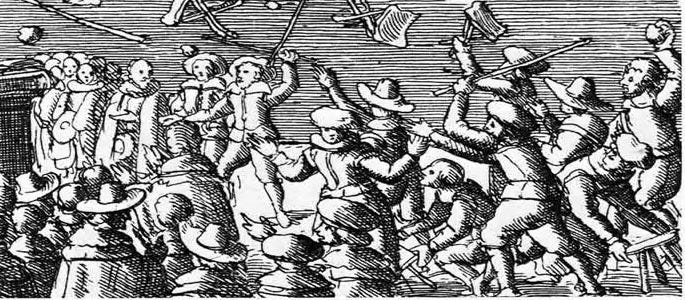
In doing so in England the capital relation saw the mass closing of the commons for sheep pastures. Not a peaceful process, peasants would be driven from the lands that they had farmed for centuries in order to become landless laborers that flooded cities, wherein they would out of desperation sell their labor power in exchange for a wage.
“As an example of the method obtaining in the 19th century, the “clearing” made by the Duchess of Sutherland will suffice here. This person, well instructed in economy, resolved, on entering upon her government, to effect a radical cure, and to turn the whole country, whose population had already been, by earlier processes of the like kind, reduced to 15,000, into a sheep-walk. From 1814 to 1820 these 15,000 inhabitants, about 3,000 families, were systematically hunted and rooted out. All their villages were destroyed and burnt, all their fields turned into pasturage. British soldiers enforced this eviction, and came to blows with the inhabitants. One old woman was burnt to death in the flames of the hut, which she refused to leave. Thus this fine lady appropriated 794,000 acres of land that had from time immemorial belonged to the clan. She assigned to the expelled inhabitants about 6,000 acres on the sea-shore — 2 acres per family”
-Marx, Das Kapital Ch 27.
Indigenous Genocide
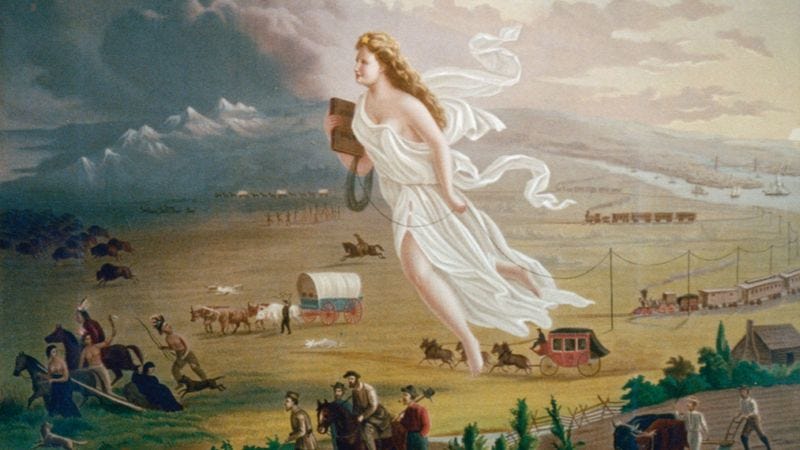
Within the Americas capital was less concerned with creating laborers but rather appropriating the raw resources of the continent including land, minerals, etc. Under the doctrine of discovery European migrants to the continent claimed that they had sovereign rights over the lands and peoples of the continent reducing the indigenous to mere occupants. In order to engage within this a clearing tactic would be systemically used in which English colonists and the us military would engage in a total asymmetrical and sometimes direct war with the native peoples of the Americas, including similar scorched earth tactics used against English peasants such as the burning of cornfields, destroying orchards, and slaughtering of live stock. Likewise broken treaties such as the cession of the Black Hills from the Lakota when gold was discovered there were heavily employed. The cutting of indigenous trade routes and means of self reproduction and survival lead to weakening of social orders and severe food shortages, commercial scalp hunting would offer public bounties for the scalps collected of indigenous peoples, and the destruction of key species to livelihood such as bison would be purposely eliminated through US Army policy. Forcible displacement such as the trial of tears, and the enforced relocation of the Navajo on the long walk would force indigenous inhabitants to reservations where they would be subject to essentially forcible confinement under military and government surveillance under fears of retributive militancy from them. Through this process American and world capital was able to secure large amounts of raw resources and wealth that built the industrial revolution and capitalist system.
This is why, to answer this sentiment which I have seen become alarmingly common without real critical understanding,
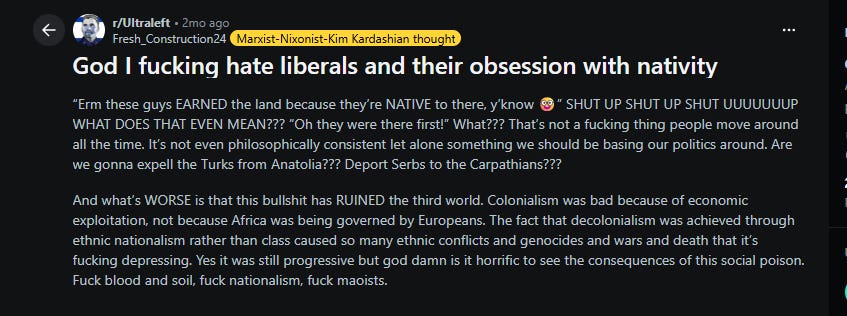
I have always believed abolishment of class society, and the birth of communism, though it must be done through the basis of class relations on the commonplace connector of almost all of humanity in them being wage laborers, should bring about a great justice for this great injustice through support for land back practices such as returning indigenous place names, support to communities to bring back suppressed languages, and ecological restoration of the Americas through working with indigenous funds of knowledge about the lands their ancestors gained knowledge of. It is not returning some kind of private ownership or counter system of commodity production, it is not depriving whites of their houses and deporting them, or the establishment of a new class society, but rather that total liberation from gender, race, and all other ills humanity must heal from when the system of commodity production and classes is abolished.
Slavery
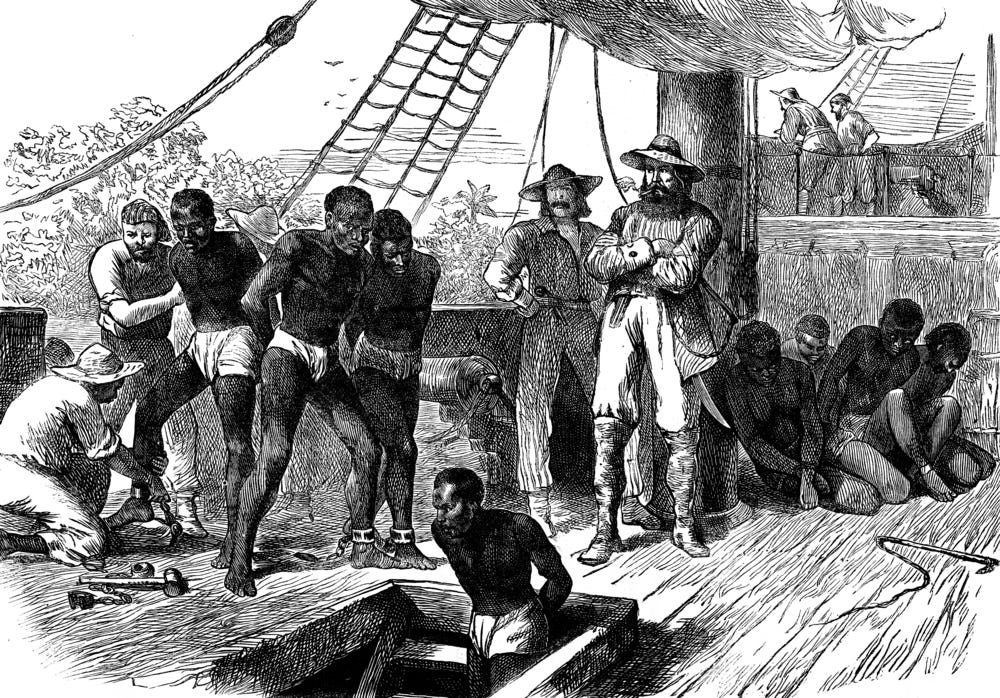
While within the old world the landless peasantry could be utilized as source of labor power the new world would need a new kind of mass labor before the creation of industrial behemoths in order to realize the value contained within the new lands they had acquired from indigenous genocide.
With the limited population of Europe in the sixteenth century, the free laborer at home was preferable to the free laborer abroad... The colonies needed labor; they grabbed the helpless wherever they could find them... The reason was economic, not racial; it had to do not with the color of the laborer, but the cheapness of the labor.
-Eric Williams
The wealth generated from the transport and labor of the slave system would create the wealth needed to do the industrial revolution.
The triangular trade gave a triple stimulus to British industry. The Negroes were purchased with British manufactures; transported to the plantations, they produced sugar, tobacco, cotton, indigo, and other tropical products, the processing of which created new industries in England; while the maintenance of the Negroes and their owners on the plantations provided another market for British industry, New England agriculture, and the Newfoundland fisheries…By 1750 there was hardly a trading or a manufacturing town in England which was not in some way connected with the triangular or direct colonial trade. The profits obtained provided one of the main streams of that accumulation of capital in England which financed the Industrial Revolution.
-Eric Williams
Colonialism
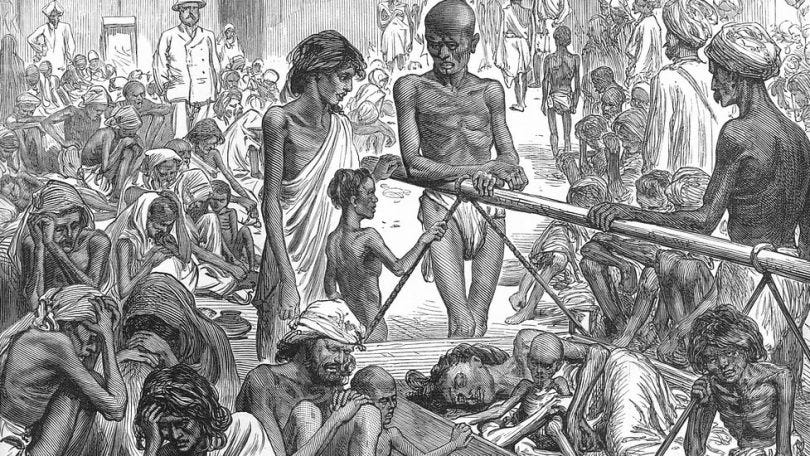
Colonialism saw European powers looking for more raw resources to feed their birthing beast of capital, and new human labor power to fuel its furnace expansion over the world. In doing so the capital relation was made global with the proletariat being produced as a global class. All across the world in order to realize this it would see a similar story played out of that in England as
for the period from 1820 to 1950, which for much of the world was characterized by colonization, the destruction of subsistence economies, and the enclosure of commons would occur. As peasant peoples would be deprived form their traditional sources of self survival the results would be horrific
British colonial policy induced serial famines that killed tens of millions of people, with life expectancy collapsing by 20%, “a deterioration in human health probably without precedent in the subcontinent’s long history of war and invasion”
-Jason Hickel
The colonies would become exporters of commodity capital, their socially necessary labor time congealed within the raw materials that would be finished in European factories then sold back to them in order to realize said value on the market. Providing European empires with a dual benefit, the establishment of a global relation of capital required nothing but the upmost violence, coercion, destruction and genocide.
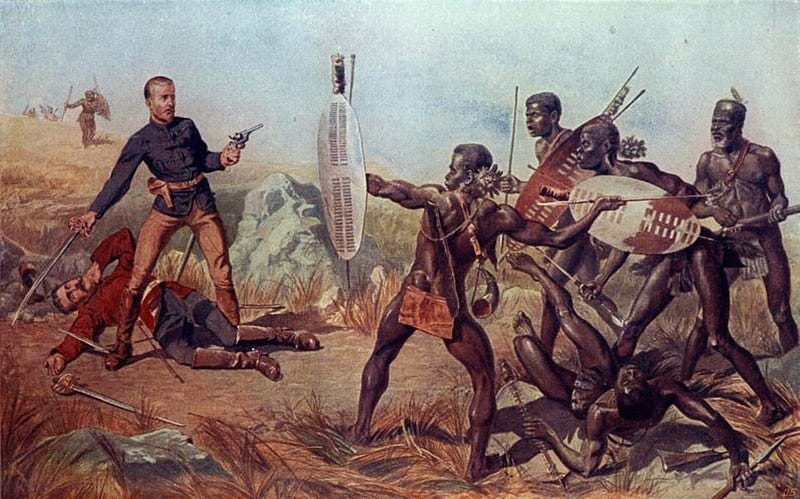
For example in the Anglo Zulu wars the British empire would implement a systematic strategy of burning homes, seizing cattle, and destruction of the economic foundations of the Zulu land, capitalizing off of the 1877 drought to break the Zulu kingdom and its economic structure and incorporate it into the folds of capital. A process of almost total societal destruction.
Women
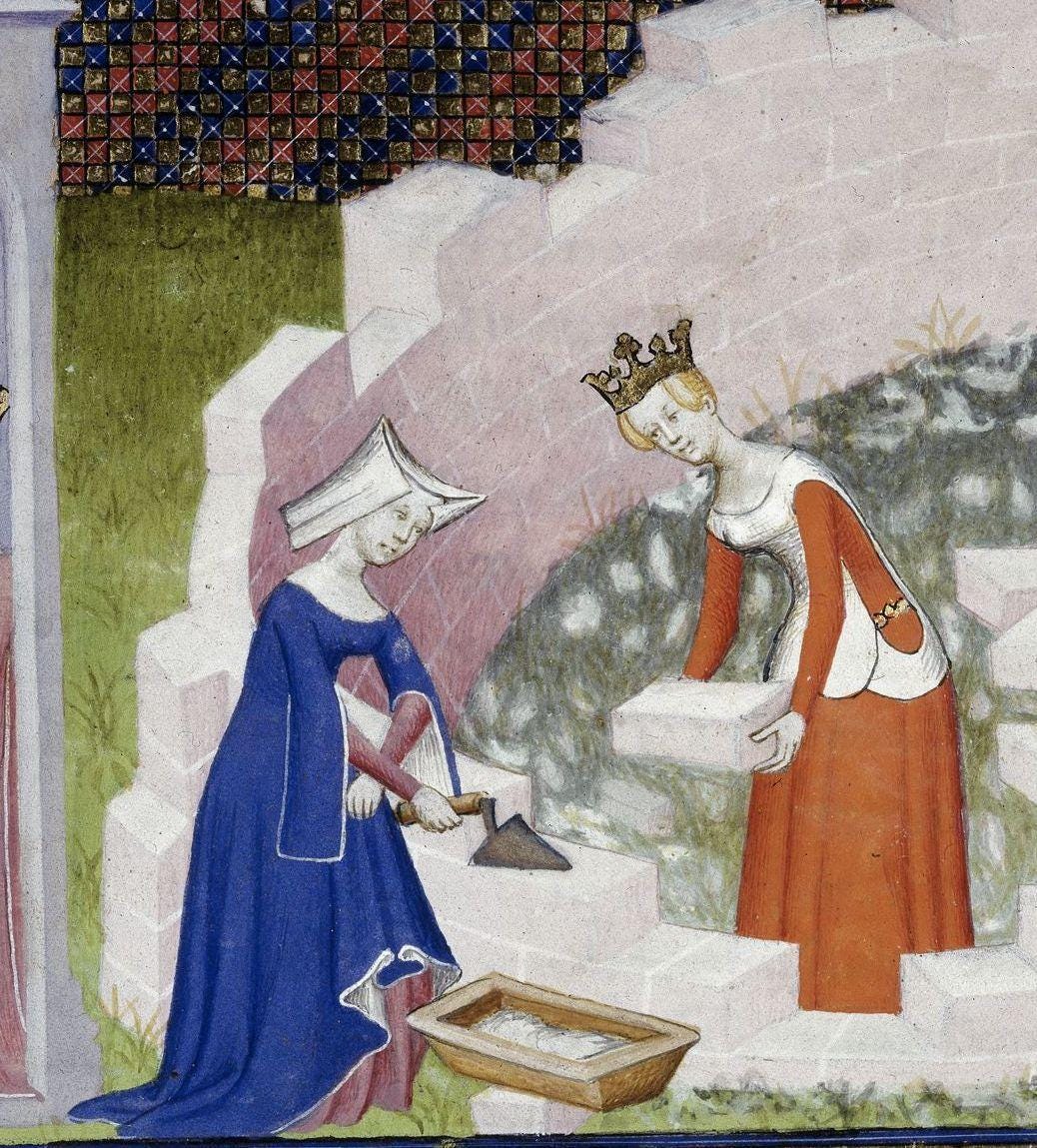
Capitalism needs an army of labor power to produce its commodities. During times of expansion it demands expansion in population from workers, during contraction it demands less children so that it can lessen its growing relative surplus population. Capitalism tells people to have babies when it needs new value production, and when its organic composition and rates of profits no longer require it, so they tell them to stop. Therefore control of reproduction ensured control of future labor power. In order to ensure future labor power, capital had to separate production and reproduction in the subsistence feudal economy, in order to create stringent women’s roles in which the domestic labor required to produce future wage laborers was employed. In feudalism the separation between domestic labor and subsistence labor was fluid, peasant women had direct access to land and could farm. This all changed with capital through first forcing women from control of their contraception and abortion, and then the witch hunts in order to sow atomization between working class men and women this process was achieved.
The witch-hunt deepened the divisions between women and men, teaching men to fear the power of women, and destroyed a universe of practices, beliefs, and social subjects whose existence was incompatible with the capitalist work discipline, thus redefining the main elements of social reproduction”. With these new stringent roles for women as basically factories of producing future labor power to supply capitals factories and produce commodities was secured.
-Silvia Federici
Conclusion
Oftentimes we are told that we are in a world of our own choosing, that we chose to sell our labor power to capital and therefore if we feel as workers we are being exploited we can choose to go to any other employer. Built into this worldview is the assumption that the capital as a relation established itself between two consenting parties hundreds of years ago and that we as the children of those establishments continue this consensual relation. And yet no one chose to be born into a world in which we are forced to sell our labor power to capital in exchange for a wage, and neither did any of our ancestors. They were all in some way or another forcibly and violently coerced into this relationship. This of course begs the question, if this relation was not established consensually, what makes it consensual now?
The ability to sell our labor power to different flavors of capital in the open market? Whether one sells their labor power to capitalist A, B, C…Z they are still operating within a system where they are forced into this relation, in which their ‘chosen’ capitalist is allowed to accumulate a great tool of social control and coercion through capital. And of course they through the organic composition of capital over time are incentivized to fire, downsize, replace their workers with machines, and lower pay, and or keep pay the same while inflation runs rampant.
Perhaps the miniscule chance of entering the gated halls of capital and being able to buy other’s labor power makes it consensual? I suppose if I put mice in a maze and their only options were to hit buttons of their choosing for 8 hours a day, or in a very small chance to become a maze runner, I too can claim that they have some consent within the logic of the maze, but stepping outside of it and looking at the maze objectively there’s no consent present. All paths are predetermined, and I control the maze wholly. The only way to truly exercise consent would be the ability to tear down the boards themselves and the relation established by the maze wholly.
‘A fair day’s wage for a fair day’s work!’ they ought to inscribe on their banner the revolutionary watchword, ‘Abolition of the wages system!
-Marx
Sources
https://www.sciencedirect.com/science/article/pii/S0305750X22002169
https://www.sackett.net/An-Indigenous-Peoples-History-of-the-United-States-Ortiz.pdf
https://www.marxists.org/archive/marx/works/1867-c1/ch27.htm
https://files.libcom.org/files/Caliban%20and%20the%20Witch.pdf
Im semi active on ultraleft and i remember that post. its my firm belief that the reason land back is villanized by communists is because of the name insinuating that land is given to indigenous peoples to form a pseudo ethno state (which i think is the intention of many leftists and liberals, and from my understanding, maoists) instead of given to the commons. its an offshoot of disdain for identity politics being shifted into disdain for anything political relating to any identity by consumption of either goomba fallacies or misunderstandings of namings.
btw trail of tears is spelled incorrectly
and what Eric Williams book is that? My mom has been interested in colonial history recently, her bdays coming up. Don’t see it in the sources.