
Introduction to Grundrisse

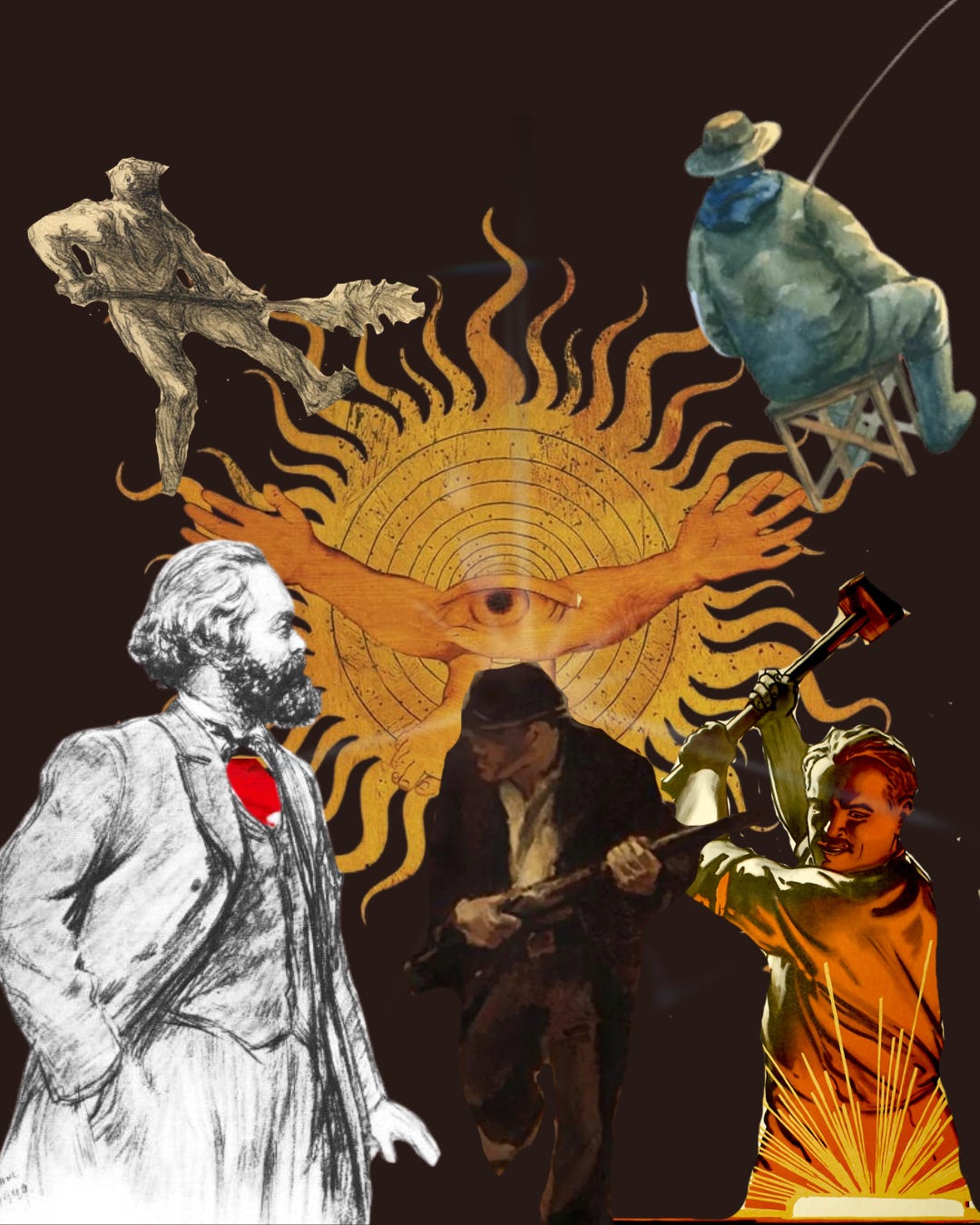
The copy we are using: https://www.marxists.org/archive/marx/works/download/pdf/grundrisse.pdf
Introduction, Personal Essays, Limitations, My Interpretations, and Core Propositions
Important note: Whenever I modified Marx’s quotes, I used [PP:] (PokePreet) to signify that it was my addition to the quote for clarity, and “PokePreet Opinion:” for where I asserted independent thought. However, I forgot to label every single bracket I added and every opinion. I also bolded the parts of the quotes I found most important. Though the content of the quotes is largely unchanged, I believe these quotes should not be read as the complete originals of Marx’s, but only for educational purposes; this text should be read as my interpretation of his work.
I think reading this book has made me realize that the accusations falsifiers of Marxism make against us—those who uphold his original thought—that Marx’s analysis is simply old and antiquated, and that holding onto it is dogma, come from genuine or purposeful ignorance of his entire schema. Marx’s most radical slaughter of idealism came from his viewing capital not as circulation, distribution, or money, but as a social relation between wage labor and capital, born of simple circulation. Those false prophets of Marx who sling terms such as “dialectical, materialist, idealist, ultra, infantile” use them to cover the great stink of their bullshit. Namely, they do not want us to look at political economy through the concrete social relations between wage labor and capital, mediated through the state form within their favorite experiments as they actually exist today, but rather through the ideals of what they claim they will transform into. In doing so, they can claim every last thing Marx identifies in this series of notes as fundamental to a capitalist mode of production (money, wage labor, accumulation, self-expansion, the value form) as socialism, or “building socialism.”
But what they forget is that, like Lego blocks, these individual pieces fit together. For Marx, capital was that totality: a social relation between wage labor and capital. Socialism is also a social relation, one in which wage labor itself is abolished. That entails the abolition of money, commodities, the value form, alienated labor, and so much more. That is to say, their great bullshit of “building socialism,” when actually looked at objectively, just builds capitalism, expands capitalism, and expands the proletariat’s condition as a worker, not a new social relation. They act in every way antithetical to socialism while claiming to build it. In doing so, the so-called “pragmatic materialists” actually become the greatest idealists in a circus of false promises, offering the salvation of socialism at some predetermined future point—but only if we continue to accumulate capital and reproduce the proletarian condition infinitely now. How absurd!
Socialism is a social relation, one that—with our current global manufacturing and technical/scientific capacity in factories, computers, the internet, possibly AI, and hyper-knowledgeable interconnected networks of communication and information sharing—could have been born yesterday, could be born today, and could be born tomorrow. It would not be in its completed final form. Still, it would certainly be born of the expulsion of the entire wage labor system and money form, the use of labor vouchers that don’t circulate, and, of course, the seizure of the means of production, beginning the abolition of the proletariat as a class in itself. Rather, we are told that states that keep the wage relation, nationalize production, and redistribute surplus have done something new, rather than in...reality, just replacing the many capitals with a single one that buys labor power. It is as if this state substitutes the proletariat, as if its usage of the money form and wage labor somehow produces a new mode of production simply because it redistributes surplus better. This is not socialism, but social democracy. This fetter on our mode of production as a social relation, whether capital or state capital, has become a terminal cancer—one that so-called “materialists” keep telling us will actually create a healthy body if we keep feeding it carcinogens. They claim that creating more cells may be disastrous now, but will lead to a healthier patient soon. But there is only one true chemo in the immediate moment, and the body has it available at all times: the proletariat as a revolutionary subject abolishing its own condition as the proletariat as object, and sublating the very wage labor relation that makes it the proletariat itself.
This is not an automatic process through the further accumulation of capital, but a conscious one. That is to say, building more factories will not create socialism; the proletariat in conscious movement as a class will. With our current global technical capacity, this process can happen as soon as tomorrow. It does not require every country to reach a certain level of development; rather, it requires only that the proletariat act as a global class, which it already is in practice, but not in consciousness. By wielding our immense technical capacity, we can vanquish so-called “under-development,” which our current capital, whether American or Chinese, has no true interest in abolishing, as both seek to extract value as quickly as possible across the globe. I.e., capitalism is now terminal due to its organic composition. It seeks to squeeze as much value as possible from every region and laborer, with no intention of being a progressive force anymore, leading humanity to the dangerous brink of extinction from climate change.
It is time to walk away from the truly infantile disorder of not looking at the concrete social relations that surround us every day, and instead look at capital as it actually exists, not whatever label (be it red, or red, white, and blue) capital dons. It is time to stop advocating for capital’s endless accumulation, no matter what promises it makes about its present or future, and time to start advocating for something more radical: the abolition of the proletariat as a class and of the entirety of what makes capital, capital. This fetus of socialist relations is long overdue, and any doctor who tells us we must wait for it any longer through the accumulation of even more capital utters nothing but pure shit from their mouth and distracts the proletariat from its true historical role as baby and midwife. We Marxists have only one thing left to say: no more obstacles or delays from falsifiers. We are ready; the stage has long been set and surpassed globally. Let this baby be born!
The Simple Crux of Marx’s Entire Argument
Marx’s arguments in Grundrisse all culminate in a very simple proposition: capitalism is not circulation, money, or the means of production; rather, it is a social relation between wage labor and capital. This is what allows money to be transformed into capital—one that continually expands. The capitalist buys labor power and M.O.P. (means of production); labor power produces commodities, and surplus value is realized on the market as more value than was initially put in. Labor power’s use value is in generating more value (surplus). Capital’s use value is in “productive consumption” of labor and M.O.P. to produce commodities and, therefore, self-expansion. Therefore: Money-Commodity…Production…Commodity Capital-More money, or M-C (labor power + M.O.P.)…P…C’-M’. From this core, we can access all other types of capital and the world market itself.
Capitalism as an Inherently Antagonistic Social Relation
Grundrisse is Marx asserting why labor is in such an antagonistic position to capital as a class that has to reproduce itself and gain its sustenance by selling its labor power in a form alien to itself, and yet is also the beast breathing new blood into the entire system. From simple circulation M-C-M (notice how the money doesn’t grow into more money, M’), the secret formula of capital is continually employed non-objectified labor (living labor), which it is then able to both objectify (means of production that absorb labor power) and continually expand.
Labor’s life is spent as C-M-C; they sell the commodity of their labor power in exchange for a wage, which is immediately spent on subsistence. This puts them in direct opposition to capital, which presents itself as the exact opposite formula: M-C-M’.
The C that labor sells is continually objectified by capital into a commodity and means of production (raw materials and machined labor, also created in Department 1); without labor to work on the M.O.P., it is useless itself.
In simple circulation preceding capital, M-C-M (again, notice it’s not M’; it doesn’t expand, it just uses up what is inputted), there was no self-expansion. Only with the continual consumption of labor power was capital able to expand to M-C-M’.
This gives labor the great power of being the lifeblood of the system of capital, and the working class’s conscious withholding of its labor is an even greater power that can bring the entire beast down.
Capital as a Historical Process Pokepreet Opinion:
Finally, it is the assertion that capital is a historical process—one that developed through the separation of labor and property in the landless pauper who was forced to sell the only thing he had left: his labor power. This created labor as an abstract quality. In doing so, capital created the individual as a historical product and established a true universal economic totality through the world market and a universal class relation. Whereas in previous modes of production, the economy was atomized into broken communities and the individual only existed within the context of the communal economy, now, under capitalism, he exists as individual labor that he exchanges for money. This, of course, created a universal class that is finally able to realize itself as a class in class struggle. Before, class struggle took place in atomized, isolated economies; in contrast, capital is universal, a world market, with a proletariat in every corner of the earth.
This radically puts humanity under capitalism in a special position for a sublation out of this condition through the conscious withholding of its labor power. It is a sublation in which capital and class society are done away with, as the proletariat takes the industrial revolution’s progress into its own hands and creates a world based on production for use value and not exchange. In doing so, man eliminates his own alienation, as under capital, his labor is constantly objectified into the commodity, money, and means of production (M.O.P.) around him through coercion and without his will—rather, out of desperation, as if he does not work, he starves. Instead, man now, with the rest of humanity, determines and plans the economy and what to do with his labor according to human need, and not the need to realize exchange value. Man also frees his day, as the saved labor time generated through increases in productive capacity is no longer used for the generation of more profit—nor to throw a section of humanity into unemployment and poverty—but is rather given back to humanity as free time.
Thus, with the sublation of capital relations, man as a true individual is able to be realized, as is true competition with his fellow man. Whereas under capital, individuality and competition are corrupted by the commodity form and the need to realize exchange, under socialism, man is able to exercise his potential against other men without the need to filter it through the market as exchange value, or as something able to realize exchange value. A poet no longer has to sell poetry that can turn a profit or satisfy market trends, but can craft poetry as an uncoerced expression of human life, evaluated solely for its beauty and meaning by a community freed from the cash nexus. In this way, socialism does not extinguish individuality; rather, by abolishing the market as the mediator of human worth, it liberates human activity (art, science, intellect, and athletic prowess) to be pursued for its own sake, transforming competition from a brutal struggle for survival into a free play of human capacity.
“That is to say, this consciousness is nothing but the expression of historical necessity. The proletariat “has no ideals to realise.” When its consciousness is put into practice it can only breathe life into the things which the dialectics of history have forced to a crisis; it can never ‘in practice’ ignore the course of history, forcing on it what are no more than its own desires or knowledge. For it is itself nothing but the contradictions of history that have become conscious”
-György Lukács
Thoughts on LTV PP opinion:
Marx’s LTV is not meant to calculate the prices of commodities; even he recognized that prices of commodities vary from true value due to the equalization of rates of profit, monopoly conditions, etc. His radical assertion is that even though the commodity fetish, through price, hides labor as a source of value, if workers withheld their labor power, supply and demand would mean nothing. The entire mechanism of capital would not even work. The proletariat’s labor is a funnel upon which the entirety of the system of capital rests; M.O.P. are useless and inert without it, and commodities cannot even realize value without transportation. If this funnel, becoming conscious of its unique position in history (not experienced in the atomized economies of peasants and slaves), acts, it can break the entirety of the system down. This is also why the proletariat must lead the revolution (and they can in coalition with other downtrodden classes)—not out of a moral attribute, but simply a material one. If the lumpen or peasants withhold their labor, capital can chug along fine, but if workers do so, it fundamentally cannot.
What is a Thaler?
A Thaler is a German silver dollar coin worth about 30-300$ usd, it is Marx’s currency of choice within this text
The Totality
Hegel conceptualized the totality, which Marx adopted, seeing the totality as an open, historically specific social ecosystem in continuous formation and transformation (or becoming). Rather than a static identity, the totality is driven through internal contradictions that bring it toward change, crises, or new conditions. There can also be more than one totality; capital as a totality for example has many variations (EU, Belt and Road, IMF, Nato, East, West,ect.), and it can subsume other modes of production (such as feudalism). Capital as a relation is a totality made up of many parts (money, circulation, distribution, production, class, fixed capital, labor, objectification, alienation, etc.) that together make up the whole process.
The Individual
Critique of Classical Economics [Introduction (pp. 17-44) ]
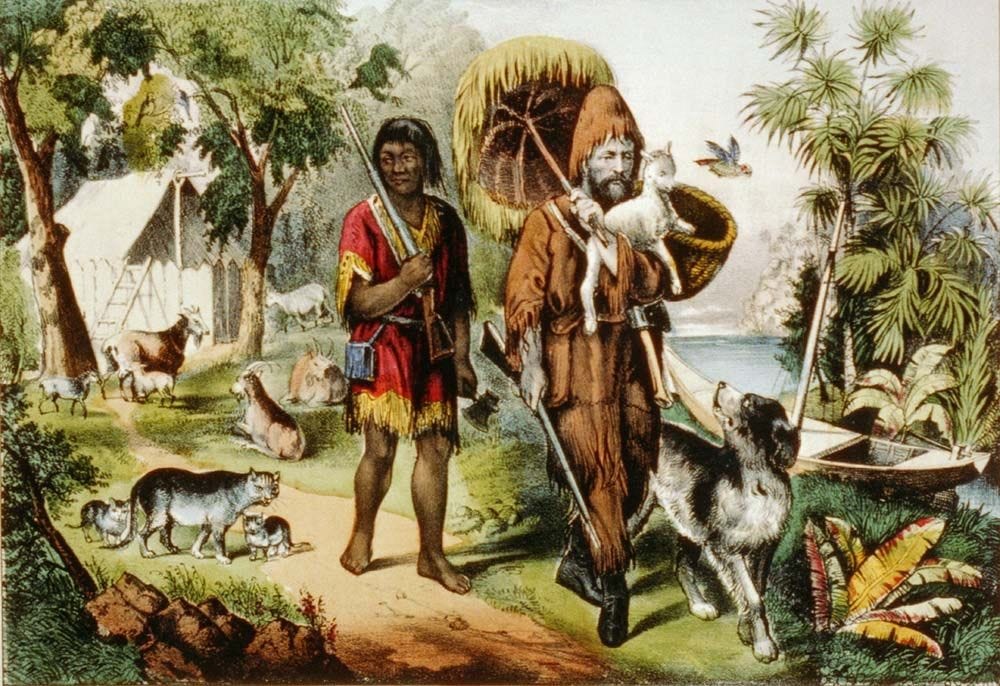
Marx begins Grundrisse with a scathing critique of classical economics’ most foundational assumption: the assumption of natural individuals engaged in independent capital relations arising out of nature. Rather, he posits that:
“Production by an isolated individual outside society – a rare exception which may well occur when a civilized person in whom the social forces are already dynamically present is cast by accident into the wilderness – is as much of an absurdity as is the development of language without individuals living together and talking to each other.”
Within the 18th century, there was a fetishization of the individual—a Robinson Crusoe-type figure who naturally possessed inherent qualities and banded together with others to create a society. Marx inverted this analysis, beginning not with the individual but with the group, as an individual cannot become a worker or capitalist without a relation to another.
“Whenever we speak of production, then, what is meant is always production at a definite stage of social development – production by social individuals.”
Production is an abstraction—one that throughout human history, though changing forms, maintains some commonalities and core needs:
Instruments: Production needs an instrument to be able to produce, even if it is just human hands themselves.
Past Labor: All production is based upon the work of past labor that retains a form within the present; capital represents the objectified value produced by workers in past cycles.
Production is made up of social relations between multiple people, not just technology or individuals; rather, it is always a certain social body, a social subject, which is active in a greater or sparser totality of branches of production. Classical economists rather see technology as solely production, and project social relations (private property, capital, etc.) as transhistorical phenomena, and not those borne out of struggle and movement in history.
“The aim is, rather, to present production…as encased in eternal natural laws independent of history, at which opportunity bourgeois relations are then quietly smuggled in as the inviolable natural laws on which society in the abstract is founded.”
Marx also critiques the idea that production must inherently necessitate private property, as early human societies often relied on communal forms of property, and many held onto them or forms of them.
“But that there can be no production and hence no society where some form of property does not exist is a tautology.”
The state and laws do not create production relations; rather, they are borne out of them. The capital mode of production creates a state and government to enforce private property relations; classical economists believe that this happens in reverse order.
Production, Distribution, and Consumption [Introduction (pp. 22-33) ]
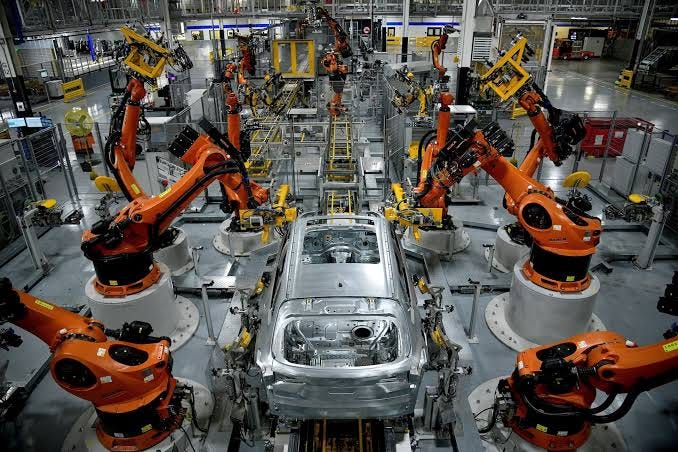
Classical economists treated production as a natural state of affairs but distribution as a social accident; by doing so, they created an illusion that distribution is separate from production. But capital commands property, and workers sell their labor power in exchange for wages in production, which inherently decides distribution upon its birth. Liberal theory treated individual freedom as absolute and natural, but bourgeois production forces the working class to engage in wage labor every day, often under coercive state mechanisms. The ideals of liberalism often face the true harshness of capitalist production. Left-wing reformers like Proudhon made the mistake of believing in production as eternal and the task at hand simply being fairer distribution, rather than breaking the wage labor relation itself, without realizing that production and distribution are interrelated.
“The opponents of the political economists [Proudhon] ..stand either on the same ground as they [classical economists], or beneath them. Nothing is more common than the reproach that the political economists view production too much as an end in itself, that distribution is just as important. This accusation is based precisely on the economic notion that the spheres of distribution and of production are independent, autonomous neighbors. Or that these moments were not grasped in their unity. As if this rupture had made its way not from reality into the textbooks, but rather from the textbooks into reality, and as if the task were the dialectic balancing of concepts, and not the grasping of real relations!”
“Production thus not only creates an object for the subject, but also a subject for the object. Thus production produces consumption (1) by creating the material for it; (2) by determining the manner of consumption; and (3) by creating the products, initially posited by it as objects, in the form of a need felt by the consumer. It thus produces the object of consumption, the manner of consumption and the motive of consumption. Consumption likewise produces the producer’s inclination by beckoning to him as an aim-determining need.”
Marx on production and consumption asserts that both are not the same, but that consumption’s origin lies in the social relations that produce objects, while bourgeois economists collapse both into a single category and treat society as a singular, abstract individual. There are definite classes in society—those that produce and those that own the means of production—who determine consumption, distribution, and exchange.
“they appear in any case as moments of one process, in which production is the real point of departure and hence also the predominant moment…In society, however, the producer’s relation to the product, once the latter is finished, is an external one, and its return to the subject depends on his relations to other individuals. He does not come into possession of it directly….Distribution steps between the producers and the products, hence between production and consumption, to determine in accordance with social laws the producer’s share will be in the world of products.”
“The structure [Gliederung] of distribution is completely determined by the structure of production…and if they appear to one epoch as natural presuppositions of production, they were its historic product for another. Within production itself they are constantly being changed….Admittedly, however, in its one-sided form, production is itself determined by the other moments. For example if the market, i.e. the sphere of exchange, expands, then production grows in quantity and the divisions between its different branches become deeper. A change in distribution changes production, e.g. concentration of capital, different distribution of the population between town and country, etc. Finally, the needs of consumption determine production. Mutual interaction takes place between the different moments. This the case with every organic whole.”
Political economy must start from a rich wealth of determinations and social relations in order to approach it as a totality (whole). The mistake with idealism, as opposed to materialism, is that it sees the state, society, and the whole as the most pure expression of thought, and not thought and the state as an organic result of concrete relations (wage labor, capital, etc.).
The Theory of Alienation [Notebook VII (pp. 749-751)]
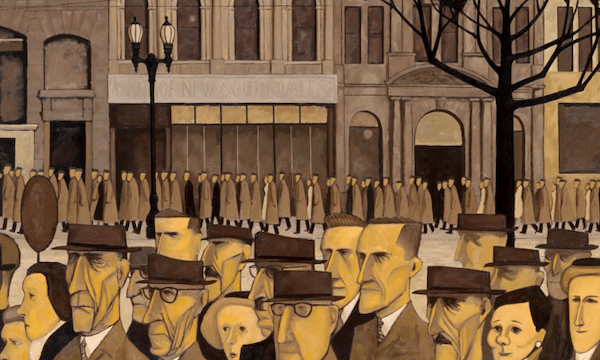
Alienation was a concept started by Hegel, to whom it was a crisis of consciousness—one in which a gap was created between a previous framework of thought and the objective world, which didn’t totally fit said framework. This would be solved through the negation of the old framework while retaining parts of its previous elements. Like a child learning to ride a tricycle, having to evolve to a two-wheeled bike when they suddenly meet a large hill, the subject retains its old habits while sublating to a higher form. Marx rooted alienation not in a crisis of consciousness, but rather in the material mode of production and concrete social relations; namely, that man was alienated from the very product of his own labor through coerced work forced upon him by class society. This alienation was overcome through a change in the mode of production through revolution—a physical sublation, not a conscious one.
“In this way Hegel fell into the illusion of conceiving the real as the product of thought concentrating itself, probing its own depths, and unfolding itself out of itself, by itself, whereas the method of rising from the abstract to the concrete is only the way in which thought appropriates the concrete, reproduces it as the concrete in the mind…The totality as it appears in the head, as a totality of thoughts, is a product of a thinking head, which appropriates the world in the only way it can, a way different from the artistic, religious, practical and mental appropriation of this world. The real subject retains its autonomous existence outside the head just as before; namely as long as the head’s conduct is merely speculative, merely theoretical. Hence, in the theoretical method, too, the subject, society, must always be kept in mind as the presupposition.”
To further prove his point, Marx points toward how simple concepts like money did not reach their full, mature development until capitalism, where all labor was commodified, whereas in previous economies—like the Roman—tribute was still heavily relied upon. Meanwhile, complex concepts like communal property and exchange could exist in less developed economies (like Slavic communes or the Inca), showing how the concrete shapes concepts. If it were the other way around, simple concepts would have reached their maturity much earlier. Labor, though an ancient concept, only developed its highest practical truth as a real abstraction under capitalism, where, to modern workers, specific types of labor no longer mattered; they could switch jobs rather easily, simply seeking a wage to survive, partially thanks to industrialization allowing for a deskilled workforce, and the capital relation creating free bodies not bound to a single job. Capitalism is the richest concrete development of past economies, containing within it elements of past economies and human concepts (the primitive commodity, money, labor, class society), abstracted and developed to their highest form.
“Human anatomy contains a key to the anatomy of the ape.”
For example, in ancient Rome or feudal economies, not everyone needed to use money, and many could barter. Commodity production existed on the edges of economies, and labor was tied to slavery or feudal caste obligations, such as owing amounts of wheat to a lord. Therefore, it was not an abstract concept like it is in capitalism, where a worker sells their conceptual ability to do labor, and class society was fractured and non-global. On how to analyze the economy, i.e., where to start:
“The order obviously has to be (1) the general, abstract determinants which obtain in more or less all forms of society, but in the above-explained sense. (2) The categories which make up the inner structure of bourgeois society and on which the fundamental classes rest. Capital, wage labour, landed property. Their interrelation. Town and country. The three great social classes. Exchange between them. Circulation. Credit system (private). (3) Concentration of bourgeois society in the form of the state. Viewed in relation to itself. The ‘unproductive’ classes. Taxes. State debt. Public credit. The population. The colonies. Emigration. (4) The international relation of production. International division of labour. International exchange. Export and import. Rate of exchange. (5) The world market and crises.”
Money (Notebooks I and II)
Marx argued that the predominance of the money form, growing out of barter and trade outside of ancient economies, necessitated the creation of a capitalist mode of production, as wage labor both produced money and received money to reproduce itself. As a power unto itself that subsumes all individuals and alienates them by only allowing them to relate to each other through the money form, it logically follows that where there is money realized in such an advanced way as to take over a whole economy, there is capital. Socialism is the abolition of the social relations that create money, not a redistribution of it.
The Proudhonist Critique of Money [Notebook I pp. 46-57 ]
Marx attacks Proudhonists who seek to simply get rid of the gold standard as a solution to all social ills, showing that the data they use to argue that point is faulty, and that fundamentally, getting rid of the gold standard would just force a country to trade with (at the time) subpar currency.
“We have now arrived at the basic question, which is no longer connected with our point of departure. The general question is: is it possible to revolutionise the existing relations of production and the corresponding relations of distribution by means of changes in the instrument of circulation—changes in the organisation of circulation? A further question: can such a transformation of circulation be accomplished without touching the existing relations of production and the social relations based on them?”
“It should further be examined, or rather it would be part of the general question, whether the different civilized forms of money – metallic, paper, credit money, labour money (the last-named as the socialist form) – can accomplish what is demanded of them without suspending the very relation of production which is expressed in the category money, and whether it is not a self-contradictory demand to wish to get around essential determinants of a relation by means of formal modifications?”
“The various forms of money may correspond better to social production at various stages of its development; one form may remove certain shortcomings with which the other cannot cope. But none of them, so long as they remain forms of money, and so long as money remains an essential relation of production, can resolve the contradictions inherent in the money relationship, they can all only express these contradictions in one form or another. One form of wage labour may correct the abuses of another, but no form of wage labour can correct the abuse of wage labour itself. ”
The Proudhonists argued that banks’ decisions caused economic crises, as they controlled credit. Marx argued that banks were not causing crises, but rather the laws of capital themselves; banks were simply beholden to them. Marx also argues that the quantity of money doesn’t determine price, but that prices determine the quantity of money (the movement of commodities, market conditions, etc., influence how much money will be printed).
That is to say, money simply comes to match the amount of value within an economy. Printing more than there is real value, in extreme cases like Weimar Germany, results in inflation as money outstrips value in the economy. Money, thus, does not create value but responds to it.
“the quantity of means of circulation determines prices”
“The real question is: does not the bourgeois system of exchange itself necessitate a specific instrument of exchange? Does it not necessarily create a specific equivalent for all values? One form of this instrument of exchange or of this equivalent may be handier, more fitting, may entail fewer inconveniences than another. But the inconveniences which arise from the existence of every specific instrument of exchange, of any specific but general equivalent, must necessarily reproduce themselves in every form, however differently. Darimon [Proudhonist] naturally skips over this question with enthusiasm. Abolish money and don’t abolish money! Abolish the exclusive privilege possessed by gold and silver in virtue of their exclusive monetary role, but turn all commodities to money, i.e. give them all together equally a quality which no longer exists once its exclusiveness is gone.”
Money is a mirror upon real production; it reflects real crises in production. Marx imagines that there was a total crop failure in a country, and only a small handful of grain was left; that small handful of grain’s price rose to cover all the grain that went missing.
On paper, nothing was affected, and the economy didn’t lose any money. But in reality, capitalists and workers would suddenly be expending immense labor value in order to buy very little grain. As a result, entire sectors of the economy would have deficits elsewhere and would crash, as workers’ incomes would suddenly not be enough to buy other goods. Capital would have overproduced commodities with no buyers, leading to cuts in wages, and capitalists would not have enough available to continue buying the means of production.
Even in a barter system, the problem would be the same, as contracts are based on average labor time (socially necessary labor time).
“Exports of gold are not the cause of the grain crisis, but the grain crisis is the cause of gold exports.”
“Scotland is important here because it shows on the one hand how the monetary system can be completely regulated on the present basis – all the evils Darimon [Proudhonist] bewails can be abolished – without departing from the present social basis; while at the same time its contradictions, its antagonisms, the class contradiction etc. have reached an even higher degree than in any other country in the world.”
“Since this depreciation of metallic money (and of all kinds of money which rest on it) always precedes its appreciation, they ought to have formulated the problem the other way round: how to prevent the periodic depreciation of money (in their language, to abolish the privileges of commodities in relation to money). In this last formulation the problem would have reduced itself to: how to overcome the rise and fall of prices. The way to do this: abolish prices. And how? By doing away with exchange value. But this problem arises: exchange corresponds to the bourgeois organization of society. Hence one last problem: to revolutionize bourgeois society economically. It would then have been self-evident from the outset that the evil of bourgeois society is not to be remedied by ‘transforming’ the banks or by founding a rational ‘money system’”
“What determines value is not the amount of labour time incorporated in products, but rather the amount of labour time necessary at a given moment... the labour time accumulated in a given quantity of gold, in contrast, must constantly rise or fall in relation to present, living labour time. ” (Socially Necessary Labor Time)
Capital presupposes money, and hence the maintenance of a money system—even some sort of labor ticket, as Proudhon proposed—would necessitate capital relations.
“First of all: if we once presuppose money, even if it is only time-chits, then we must also presuppose the accumulation of this money, as well as contracts, obligations, fixed burdens etc., which are entered into in the form of this money. The accumulated chits would constantly appreciate together with the newly issued ones, and thus on the one hand the rising productivity of labour would go to the benefit of non-workers, and on the other hand the previously contracted burdens would keep step with the rising yield of labour. The rise and fall in the value of gold or silver would be quite irrelevant if the world could be started afresh at each new moment and if, hence, previous obligations to pay a certain quantity of gold did not survive the fluctuations in the value of gold. The same holds, here, with the time-chit and hourly productivity.”
“The value of all commodities is determined by their cost of production, in other words by the labour time required to produce them. Their price is this exchange value of theirs, expressed in money.”
Value and Price [pp. 117-122, 133-146]
Value is determined by socially necessary labor time (the average time of production across an industry). It is not a fixed physical property of an object; rather, it is a long-term average. Price, on the other hand, is regulated by value; it swings above and below in the short term, with the long-term average being value.
“The price of a commodity constantly stands above or below the value of the commodity, and the value of the commodity itself exists only in this up-and-down movement of commodity prices. Supply and demand constantly determine the prices of commodities; never balance, or only coincidentally; but the cost of production, for its part, determines the oscillations of supply and demand. The gold or silver in which the price of a commodity, its market value, is expressed is itself a certain quantity of accumulated labour, a certain measure of materialized labour time.”
The Proudhonists seek to fix everything to a single labor ticket price. Marx points out that if a factory overproduces a commodity far past demand, without the violent drop in price far below value, the factory would never know to stop producing. Likewise, their plan to turn everything into money abolishes money, but also recreates it everywhere else.
“The difference between price and value, between the commodity measured by the labour time whose product it is, and the product of the labour time against which it is exchanged, this difference calls for a third commodity to act as a measure in which the real exchange value of commodities is expressed [money]. Because price is not equal to value, therefore the value-determining element – labour time – cannot be the element in which prices are expressed, because labour time would then have to express itself simultaneously as the determining and the non-determining element, as the equivalent and non-equivalent of itself.”
The commonality of all commodities which allows them to be exchanged with one another is the labor time congealed within them, i.e., the equivalent social relations it took to produce them.
“Value is their social relation, their economic quality. A book which possesses a certain value and a loaf of bread possessing the same value are exchanged for one another, are the same value but in a different material. As a value, a commodity is an equivalent for all other commodities in a given relation”
Money embodies a manifestation of these social relations as a physical means of universal exchange between commodities.
“The exchange value of a commodity, as a separate form of existence accompanying the commodity itself, is money; the form in which all commodities equate, compare, measure themselves; into which all commodities dissolve themselves; that which dissolves itself into all commodities; the universal equivalent.”
Exchange value acts as a double existence (contradiction) to the use of the commodity itself, the commodity and producer becoming alien from its own use as they become purely beholden to the exchange relationship (e.g., baby formula is no longer about feeding babies; it can sit on shelves gathering dust in order to realize its exchange value while babies go hungry).
“But as the latter grows, so grows the power of money, i.e. the exchange relation establishes itself as a power external to and independent of the producers. What originally appeared as a means to promote production becomes a relation alien to the producers…money does not create these antitheses and contradictions; it is, rather, the development of these contradictions and antitheses which creates the seemingly transcendental power of money”
As long as exchange value exists, so does money in some form or another.
“The properties of money as (1) measure of commodity exchange; (2) medium of exchange; (3) representative of commodities (hence object of contracts); (4) general commodity alongside the particular commodities, all simply follow from its character as exchange value separated from commodities themselves and objectified.”
Money under capital is able to fully realize itself by turning all goods produced into commodities traded for money (replacing barter and goods produced for self-use), and turning all labor into wage labor. What determines the amount of money needed in circulation?
“( 1 ) the level of the commodity price; (2 ) the mass of circulating commodities at definite prices; further, ( 3 ) the law that money as medium of circulation becomes coin, mere vanishing moment, mere symbol of the values it exchanges”
The Nature of Economic Crises [Notebook IV-V pp. 328-373]
The effect, in general, of all of this is the creation of market crises. Under barter systems, purchase and sale occurred at the same time. Under a money system, buying and selling are temporally separate, since they no longer have to happen at the same time. More products can be created than needed, leading to crises of overproduction.
What worsens this is that factories often sell to middlemen (merchants), who buy products not for their own use, but to resell to the working class, who help a commodity realize its exchange value. Finally, in the chain, merchants can keep demanding and buying products far beyond workers’ ability to buy or need.
Money solves the issues of commodity exchange by becoming a general commodity, but by becoming a general commodity, it becomes beholden to commodity laws (supply-demand, inflation) and therefore allows for crises.
“But on one side, exchange value naturally remains at the same time an inherent quality of commodities while it simultaneously exists outside them; on the other side, when money no longer exists as a property of commodities, as a common element within them, but as an individual entity apart from them, then money itself becomes a particular commodity alongside the other commodities…We see, then, how it is an inherent property of money to fulfil its purposes by simultaneously negating them; to achieve independence from commodities; to be a means which becomes an end; to realize the exchange value of commodities by separating them from it; to facilitate exchange by splitting it; to overcome the difficulties of the direct exchange of commodities by generalizing them; to make exchange independent of the producers in the same measure as the producers become dependent on exchange.”
Marx attacks how classical economists say that capitalism allows individuals to express their individuality, as said free labor is actually tied to brutal market conditions of interdependence. Workers have to sell their labor power in exchange for a wage in order to reproduce themselves as a class. Likewise, everyone is alienated from their own ability to do work; as it is given an exchange value, it becomes alien from them and is no longer their own, but rather beholden to the money relation. Everyone is in competition with one another—hardly individual freedom.
“The social character of activity, as well as the social form of the product, and the share of individuals in production here appear as something alien and objective, confronting the individuals, not as their relation to one another, but as their subordination to relations …individuals are subsumed under social production; social production exists outside them as their fate”
Individualism under Communism
Marx then describes how communism, with the abolition of the law of value and coerced alienated labor, allows for true individualism.
“Free individuality, based on the universal development of individuals and on their subordination of their communal, social productivity as their social wealth, is the third stage…. Patriarchal as well as ancient conditions (feudal, also) thus disintegrate with the development of commerce, of luxury, of money, of exchange value, while modern society arises and grows in the same measure.”
Money can only result from a society in which people’s own social relationship is alienated from themselves, so that it therefore becomes independent from their own labor. But the creation of a world market creates billions of people who are connected to one another through their alienated social relations and labor confronting them as a market force. In addition, capital builds productive wonders all across the world; this creates a global class able to realize itself, sublate its own existence, and abolish class society itself.
Through the destruction of class society and coerced labor, true individualism under communism is able to be realized.
Under capital, the creation of a commodity is private, but exchange is social and therefore socially determined. This means that there is a pool of labor value produced that socially necessary labor time allocates to the price of the commodity according to market forces.
On describing Communism:
“Instead of a division of labour, such as is necessarily created with the exchange of exchange values, there would take place an organization of labour whose consequence would be the participation of the individual in communal consumption”
Advances in productivity under socialism would no longer be used to accumulate more capital; rather, the saved time would be used to benefit people with more free time for human development.
“In the basis of communal production, the determination of time remains, of course, essential. The less time the society requires to produce wheat, cattle etc., the more time it wins for other production, material or mental. Just as in the case of an individual, the multiplicity of its development, its enjoyment and its activity depends on economization of time. Economy of time, to this all economy ultimately reduces itself.”
Gold
Explaining why gold has value but stones don’t:
“For something to become an object of exchange, to have exchange value, it must not be available to everyone without the mediation of exchange; it must not appear in such an elemental form as to be common property. To this extent, rarity is an element of exchange value…Its production requires, hence, no development of the productive forces. Nature does most of the work in that regard”
Tracing the history of gold and silver as money, Marx notes how the labor time required to extract them within a historical era determined their value. When gold was easy to get and silver harder due to a lack of technology, the ratio between a bar of gold and its worth in silver was around 6 (gold) to 1 (silver). But thanks to breakthroughs in technology and the use of slaves, silver became easy and abundant to extract, flipping the value by the late Roman Empire to 18 (gold) to 1 (silver).
“since mechanics and geometry had made immense progress from Euclid to Archimedes, it was possible to exploit with profit the rich veins of silver mined in Asia…the value ratio between them necessarily changed, so that the livre of gold… came to be worth 18 livres of the latter metal in the year A.D. 422. Thus, it rose from 10:1 to 18:1.”
Circulation and money do not create prices; they just realize already predetermined prices, which are regulated over time by the law of value.
“Money only circulates commodities which have already been ideally transformed into money, not only in the head of the individual but in the conception held by society… Money has a dual character: it is (1) measure, or element in which the commodity is realized as exchange value, and (2) means of exchange, instrument of circulation, and in each of these aspects it acts in quite opposite direction…What money circulates is not commodities but their titles of ownership; and what is realized in the opposite direction in this circulation, whether by purchase or sale, is again not the commodities, but their prices. ”
“The precondition of commodity circulation is that they be produced as exchange values, not as immediate use values, but as mediated through exchange value.”
“Thus already in the quality of money as a medium, in the splitting of exchange into two acts, there lies the germ of crises, or at least their possibility, which cannot be realized, except where the fundamental preconditions of classically developed, conceptually adequate circulation are present.”
With the separation of money from the product (commodity production and money growing from barter), money becomes king. It takes over human relations, and money transforms from a servant of trade into a despot. The use value of a good no longer matters; only its exchange value matters. It is therefore rendered useless by the market if its exchange value cannot be realized.
“In the period of the rising absolute monarchy with its transformation of all taxes into money taxes, money indeed appears as the moloch to whom real wealth is sacrificed.”
Likewise, while economists treat buying and selling as one single action and not something separated by time and space (you can accumulate commodities and money), they overlook that the physical act of separating both allows for supply and demand to become dangerously out of whack.
“The splitting of exchange into purchase and sale makes it possible for me to buy without selling (stockpiling of commodities) or to sell without buying (accumulation of money). It makes speculation possible.”
“A product posited as exchange value is in its essence no longer a simple thing; it is posited in a quality differing from its natural quality; it is posited as a relation, more precisely as a relation in general, not to one commodity but to every commodity, to every possible product. It expresses, therefore, a general relation; the product which relates to itself as the realization of a specific quantity of labour in general, of social labour time, and is therefore the equivalent of every other product in the proportion expressed in its exchange value. Exchange value presupposes social labour as the substance of all products, quite apart from their natural make-up.”
“If 1 bushel of wheat has the price of 77s. 7d. or of 1 ounce of gold, then this can be a greater or lesser value, since 1 ounce of gold will rise or fall in relation to the quantity of labour required for its production…The price expresses its exchange value only in a unit common to all commodities; presupposes therefore that this exchange value is already regulated by other relations. ”
“In exchange value, commodities (products) are posited as relations to their social substance, to labour; but as prices, they are expressed as quantities of other products of various natural make-ups”
Gold standard money does not actually represent the actual amount of gold physically available; it is more about symbolically representing the amount of labor value within an economy through gold. The amount of gold itself, as a result, becomes irrelevant, and often the money ends up representing more gold than is physically available, with Marx predicting the paving of the way for our modern fiat currency.
“It is only a semblance, as if the point were to exchange the commodity for gold or silver as particular commodities: a semblance which disappears as soon as the process is ended, as soon as gold and silver have again been exchanged for a commodity, and the commodity, hence, exchanged for another. The character of gold and silver as mere media of circulation, or the character of the medium of circulation as gold and silver is therefore irrelevant to their make-up as particular natural commodities…The genuine pound is, therefore, in this process, nothing more than a symbol, in so far as the moment in which it realizes prices is left out, and we look only at the totality of the process, in which it serves only as medium of exchange and in which the realization of prices is only a semblance, a fleeting mediation….But in so far as the realization of the price is not the final act, and the point is not to possess the price of commodities as price, but as the price of another commodity, to that extent the material of money is irrelevant, e.g. gold and silver. ”
“From this it follows that money as gold and silver, in so far as only its role as means of exchange and circulation is concerned, can be replaced by any other symbol which expresses a given quantity of its unit, and that in this way symbolic money can replace the real, because material money as mere medium of exchange is itself symbolic.”
Out of the growth of simple circulation (Commodity-Money-Commodity), where money disappears and a person gets a commodity with use value at the end, it transforms into capital (Money-Commodity-More Money), which transitions purely to the realization of exchange value. Money, as a result, becomes independent wealth; it becomes a power that stands over the market, seeking only quantitative growth. It is a medium which becomes a tool of social control, as it is able to buy labor power and the means of production. It becomes a social relation that values itself and alienates human beings rather than being their tool—it becomes more powerful than man, as man serves it.
“But first it must be noted that, once the quality of money as an intrinsic relation of production generally founded on exchange value is presupposed, it is possible to demonstrate that in some particular cases it does service as an instrument of production. ‘The utility of gold and silver rests on this, that they replace labour.’ (Lauderdale, p. 11.)...Thus, money is now exchange value become independent (it never puts in more than a fleeting appearance as such, as medium of exchange) in its general form”
“With money, general wealth is not only a form, but at the same time the content itself. The concept of wealth, so to speak, is realized, individualized in a particular object”
“It is the ‘précis de toutes les choses’, in which their particular character is erased; it is general wealth in the form of a concise compendium, as opposed to its diffusion and fragmentation in the world of commodities. While wealth in the form of the particular commodity appears as one of the moments of the same, or the commodity as one of the moments of wealth; in the form of gold and silver general wealth itself appears as concentrated in a particular substance. Every particular commodity, in so far as it is exchange value, has a price, expresses a certain quantity of money in a merely imperfect form, since it has to be thrown into circulation in order to be realized, and since it remains a matter of chance, due to its particularity, whether or not it is realized. ”
“Its relation to the individual thus appears as a purely accidental one; while this relation to a thing having no connection with his individuality gives him, at the same time, by virtue of the thing’s character, a general power over society, over the whole world of gratifications, labours, etc. It is exactly as if, for example, the chance discovery of a stone gave me mastery over all the sciences, regardless of my individuality. The possession of money places me in exactly the same relationship towards wealth (social) as the philosophers’ stone would towards the sciences.”
“Money is therefore not only an object, but is the object of greed [Bereicherungssucht]. It is essentially auri sacra fames. Greed as such, as a particular form of the drive, i.e. as distinct from the craving for a particular kind of wealth, e.g. for clothes, weapons, jewels, women, wine etc., is possible only when general wealth, wealth as such, has become individualized in a particular thing, i.e. as soon as money is posited in its third quality.”
The highest development of money comes into being with the predominance of wage labor producing exchange value (money), and labor power being able to be bought with money (capitalism) as a social relation.
“It is inherent in the simple character of money itself that it can exist as a developed moment of production only where and when wage labour exists; that in this case, far from subverting the social formation, it is rather a condition for its development and a driving-wheel for the development of all forces of production, material and mental…as material representative of general wealth, as individualized exchange value, money must be the direct object, aim and product of general labour, the labour of all individuals. Labour must directly produce exchange value, i.e. money. It must therefore be wage labour. ”
The illusion of money as a source of value, and not labor and productivity, led to the exploration of the world for gold and its colonization. This, in turn, provided the raw resources, labor power, and the destruction of old economies for wage labor and capital to flourish.
“This is why the search for and discovery of gold in new continents, countries, plays so great a role in the history of revaluation, because by its means colonization is improvised and made to flourish as if in a hothouse. The hunt for gold in all countries leads to its discovery; to the formation of new states; initially to the spread of commodities, which produce new needs, and draw distant continents into the metabolism of circulation, i.e. exchange. Thus, in this respect, as the general representative of wealth and as individualized exchange value, it was doubly a means for expanding the universality of wealth, and for drawing the dimensions of exchange over the whole world; for creating the true generality [Allgemeinheit] of exchange value in substance and in extension.”
In ancient economies, humans related to one another through membership in a group, whereas with the victory of the money form, it became the true source of connection for individuals as something external to them. With the erosion of ancient economies through primitive accumulation, former peasants were forced to sell their labor power in exchange for a wage through the medium of money. Capital is money that has gained the power of social control.
“The community of antiquity presupposes a quite different relation to, and on the part of, the individual. The development of money in its third role therefore smashes this community. All production is an objectification [Vergegenständlichung] of the individual. In money (exchange value), however, the individual is not objectified in his natural quality, but in a social quality (relation) which is, at the same time, external to him.”
In ancient communities, commodities were just exchanged for commodities, while any excess was traded for money (C-C, C-M-C). Out of this, the money form grew as a national medium of exchange, and as it became global, it took on a life of its own as a world market was created (M-C-M’). On the global stage, it became a raw commodity of exchange. The world market was no longer about the swapping of excess goods, but rather the need to realize value, with the act of buying and selling separated, allowing for large crises of overproduction.
Money also gets hoarded by the wealthy out of circulation, functioning as a hoarded tool of social control.
“It is the available overflow of an overall production which lies outside the world of exchange values. This still presents itself even on the surface of developed society as the directly available world of commodities. But by itself, it points beyond itself towards the economic relations which are posited as relations of production. The internal structure of production therefore forms the second section; the concentration of the whole in the state the third; the international relation the fourth; the world market the conclusion, in which production is posited as a totality together with all its moments, but within which, at the same time, all contradictions come into play. The world market then, again, forms the presupposition of the whole as well as its substratum. Crises are then the general intimation which points beyond the presupposition, and the urge which drives towards the adoption of a new historic form…money, as we have seen, in the form in which it independently steps outside of and against circulation, is the negation (negative unity) of its character as medium of circulation and measure. ”
“Firstly. Money is the negation of the medium of circulation as such, of the coin…secondly: Money is the negation of itself as mere realization of the prices of commodities, where the particular commodity always remains what is essential. It becomes, rather, the price realized in itself and, as such, the material representative of wealth as well as the general form of wealth in relation to all commodities, as merely particular substances of it; but Thirdly: Money is also negated in the aspect in which it is merely the measure of exchange values.”
“Rothschild displays as his proper emblem, I think, two banknotes of £100,000 each, mounted in a frame. The barbarian display of gold etc. is only a more naïve form of this modern one, since it takes place with less regard to gold as money. Here still the simple glitter. There a premeditated point. The point being that it is not used as money; here the form antithetical to circulation is what is important…Money in its final, completed character now appears in all directions as a contradiction, a contradiction which dissolves itself, drives towards its own dissolution. As the general form of wealth, the whole world of real riches stands opposite it. ”
The victory of capital social relations manifested through the money form destroyed older economic relations where peasants produced goods for themselves. They became alienated from the product of their own labor as property, and labor was separated.
“Property, too, is still posited here only as the appropriation of the product of labour by labour, and of the product of alien labour by one’s own labour, in so far as the product of one’s own labour is bought by alien labour. Property in alien labour is mediated by the equivalent of one’s own labour. This form of property – quite like freedom and equality – is posited in this simple relation. In the further development of exchange value this will be transformed, and it will ultimately be shown that private property in the product of one’s own labour is identical with the separation of labour and property, so that labour will create alien property and property will command alien labour.”
Capital [Notebook II-VII pp.168-800]
Money is an objectification of social relations between people
“A difficulty which political economy attempts to evade by forgetting … is that a social relation, a definite relation between individuals, here appears as a metal, a stone, as a purely physical, external thing which can be found, as such, in nature, and which is indistinguishable in form from its natural existence. Gold and silver, in and of themselves, are not money. Nature does not produce money, any more than it produces a rate of exchange or a banker…the result of social processes; it is money. This is all the more difficult since its immediate use value for the living individual stands in no relation whatever to this role, and because, in general, the memory of use value, distinct from exchange value, has become entirely extinguished in this incarnation of pure exchange value. ”
“On the other hand, it is in the character of the money relation – as far as it is developed in its purity to this point, and without regard to more highly developed relations of production – that all inherent contradictions of bourgeois society appear extinguished in money relations as conceived in a simple form; and bourgeois democracy even more than the bourgeois economists takes refuge in this aspect (the latter are at least consistent enough to regress to even simpler aspects of exchange value and exchange) in order to construct apologetics for the existing economic relations.”
“as a human being, and that they relate to one another as human beings; that their common species-being [Gattungswesen] is acknowledged by all. It does not happen elsewhere – that elephants produce for tigers, or animals for other animals.”
Making fun of bourgeois economic theories of freedom and equality:
“If one grows impoverished and the other grows wealthier, then this is of their own free will and does not in any way arise from the economic relation, the economic connection as such, in which they are placed in relation to one another. Even inheritance and similar legal relations, which perpetuate such inequalities, do not prejudice this natural freedom and equality. If individual A’s relation is not in contradiction to this system originally, then such a contradiction can surely not arise from the fact that individual B steps into the place of individual A, thus perpetuating him.”
“In the course of science, it is just these abstract attributes which appear as the earliest and sparsest; they appear in part historically in this fashion, too; the more developed as the more recent. In present bourgeois society as a whole, this positing of prices and their circulation etc. appears as the surface process, beneath which, however, in the depths, entirely different processes go on, in which this apparent individual equality and liberty disappear.”
Marx points out that the idea of free individuals exchanging on an equal basis completely forgets about class, the coercion of labor, and capital as a powerful social tool, and that such a relation is historically transient.
“It is forgotten, on one side, that the presupposition of exchange value, as the objective basis of the whole of the system of production, already in itself implies compulsion over the individual, since his immediate product is not a product for him, but only becomes such in the social process, and since it must take on this general but nevertheless external form; and that the individual has an existence only as a producer of exchange value, hence that the whole negation of his natural existence is already implied; that he is therefore entirely determined by society; that this further presupposes a division of labour etc., in which the individual is already posited in relations other than that of mere exchanger, etc. That therefore this presupposition by no means arises either out of the individual’s will or out of the immediate nature of the individual, but that it is, rather, historical, and posits the individual as already determined by society. It is forgotten, on the other side, that these higher forms, in which exchange, or the relations of production which realize themselves in it, are now posited, do not by any means stand still in this simple form where the highest distinction which occurs is a formal and hence irrelevant one. What is overlooked, finally, is that already the simple forms of exchange value and of money latently contain the opposition between labour and capital etc. Thus, what all this wisdom comes down to is the attempt to stick fast at the simplest economic relations, which, conceived by themselves, are pure abstractions; but these relations are, in reality, mediated by the deepest antithesis, and represent only one side, in which the full expression of the antitheses is obscured.”
Marx on how French Socialists just create an alternative capitalism:
“That this reveals, on the other side, is the foolishness of those socialists (namely the French, who want to depict socialism as the realization of the ideals of bourgeois society articulated by the French revolution) who demonstrate that exchange and exchange value etc. are originally (in time) or essentially (in their adequate form) a system of universal freedom and equality, but that they have been perverted by money, capital, etc…The proper reply to them is: that exchange value or, more precisely, the money system is in fact the system of equality and freedom, and that the disturbances which they encounter in the further development of the system are disturbances inherent in it, are merely the realization of equality and freedom, which prove to be inequality and unfreedom. ”
“Money as capital is an aspect of money which goes beyond its simple character as money. It can be regarded as a higher realization; as it can be said that man is a developed ape.”
The Transition to Capitalist Production [Notebook II & III pp. 184-247]
“Mode of production founded on capital, so the same thing takes place in practice. The economists therefore necessarily sometimes consider capital as the creator of values, as their source, while at other times they presuppose values for the formation of capital, and portray it as itself only a sum of values in a particular function. The existence of value in its purity and generality presupposes a mode of production in which the individual product has ceased to exist for the producer in general and even more for the individual worker, and where nothing exists unless it is realized through circulation.”
Marx posits that, unlike what bourgeois economists want to do, capital cannot just be reduced to something simple like exchange value or circulation, as everyone participates in exchange value on a somewhat equal basis, from capitalist to worker. Nor can circulation be posited as the main mechanism of the growth of capital, as simple circulation (C-M-M-C) does not grow; rather, it equals out the values exchanged, or breaks even. It needs something else in order to become capital. Nor does merchant capital (M-C-M), which existed on the fringes of economies and saw merchants simply buying to sell.
“Commercial capital is only circulating capital, and circulating capital is the first form of capital; in which it has as yet by no means become the foundation of production. A more developed form is money capital and money interest, usury, whose independent appearance belongs in the same way to an earlier stage. Finally, the form C–M–M–C, in which money and circulation in general appear as mere means for the circulating commodity, which for its part again steps outside circulation and directly satisfies a need, this is itself the presupposition of that original appearance of merchant capital…On the other side, the circulating commodity, the commodity which realizes itself only by taking on the form of another commodity, which steps outside circulation and serves immediate needs, is similarly [the] first form of capital, which is essentially commodity capital”
“While, originally, the act of social production appeared as the positing of exchange values and this, in its later development, as circulation – as completely developed reciprocal movement of exchange values – now, circulation itself returns back into the activity which posits or produces exchange values. It returns into it as into its ground. It is commodities (whether in their particular form, or in the general form of money) which form the presupposition of circulation; they are the realization of a definite labour time and, as such, values; their presupposition, therefore, is both the production of commodities by labour and their production as exchange value”
“Circulation therefore does not carry within itself the principle of self-renewal. The moments of the latter are presupposed to it, not posited by it. Commodities constantly have to be thrown into it anew from the outside, like fuel into a fire. Otherwise it flickers out in indifference.”
Therefore, in order for money and circulation to transform into capital, we must change our lens from trade to production.
Exchange value, which exists at the edges of ancient economies that trade their excesses in the form of trading civilizations, soon begins to change the inner mechanisms of the society. In seeking a constant supply of commodities to trade, they begin shifting towards increasing production, which satisfies the needs of trade and also has the effect of transforming economies of use-value into economies of exchange-value.
“ if the trading peoples who solicit exchange appear repeatedly… and if an ongoing commerce develops…then the surplus of production must no longer be something accidental, occasionally present, but must be constantly repeated; and in this way domestic production itself takes on a tendency towards circulation, towards the positing of exchange values. At first the effect is of a more physical kind. The sphere of needs is expanded; the aim is the satisfaction of the new needs, and hence greater regularity and an increase of production…Thus, here was a circulation which presupposed a production in which only the overflow was created as exchange value; but it turned into a production which took place only in connection with circulation, a production which posited exchange values as its exclusive content.”
Capital, as Marx points out, is not simply just value that produces a profit, or past labor objectified, as that has been part of almost all previous economies (a caveman used a bow created by someone else; that would therefore be capital according to bourgeois economists). Rather, it is a self-renewing social relation that expands itself.
“If all capital is objectified labor which serves as means for new production, it is not the case that all objectified labor which serves as means for new production is capital. Capital is conceived as a thing, not as a relation.”
“The first quality of capital is, then, this: that exchange value deriving from circulation and presupposing circulation preserves itself within it and by means of it; does not lose itself by entering into it; that circulation is not the movement of its disappearance, but rather the movement of its real self-positing [Sichsetzen] as exchange value, its self-realization as exchange value…Only with capital is exchange value posited as exchange value in such a way that it preserves itself in circulation; i.e. it neither becomes substanceless, nor constantly realizes itself in other substances or a totality of them; nor loses its specific form, but rather preserves its identity with itself in each of the different substances…But it is this only because it itself is a constantly self-renewing circular course of exchanges”
“Capital becomes commodity and money alternately; but (1) it is itself the alternation of both these roles; (2) it becomes commodity; but not this or the other commodity, rather a totality of commodities. It is not indifferent to the substance, but to the particular form; appears in this respect as a constant metamorphosis of this substance; in so far as it is then posited as a particular content of exchange value, this particularity itself is a totality of particularity; hence indifferent not to particularity as such, but to the single or individuated particularity. The identity, the form of generality [Allgemeinheit], which it obtains is that of being exchange value and, as such, money. It is still therefore posited as money, in fact it exchanges itself as commodity for money. But posited as money, i.e. as this contradictory form of the generality of exchange value, there is posited in it at the same time that it must not, as in simple exchange, lose this generality, but must rather lose the attribute antithetical to generality, or adopt it only fleetingly; therefore it exchanges itself again for the commodity, but as a commodity which itself, in its particularity, expresses the generality of exchange value, and hence constantly changes its particular form.”
“The only aspect in which capital is here posited as distinct from direct exchange value and from money is that of exchange value which preserves and perpetuates itself in and through circulation.”
In order for the law of value to become the self-growing engine it did under capital, it had to overcome the limits set onto it by simple circulation, where it wasn’t able to grow. In simple circulation, labor was primary and exchange value simply a byproduct. But through the creation of the capital relation, exchange value was able to self-expand itself by becoming primary while subsuming living labor. Through finding a large supply of it willing to trade its labor power in exchange for a wage, capital was able to self-reproduce itself and expand far beyond what exchange value could under simple commodity production.
We finally arrive at Money-Commodity (Labor power + Means of Production)…Production…Commodity-More Money (M-C…P…C’-M’).
“The positively negative: Money is negated not as objectified, independent exchange value – not only as vanishing in circulation – but rather the antithetical independence, the merely abstract generality in which it has firmly settled, is negated; but thirdly: Exchange value as the presupposition and simultaneously the result of circulation, just as it is assumed as having emerged from circulation, must emerge from it again”
“Exchange value posits itself as exchange value only by realizing itself; i.e. increasing its value. Money (as returned to itself from circulation), as capital, has lost its rigidity, and from a tangible thing has become a process. But at the same time, labour has changed its relation to its objectivity; it, too, has returned to itself. But the nature of the return is this, that the labour objectified in the exchange value posits living labour as a means of reproducing it, whereas, originally, exchange value appeared merely as a product of labour.”
“Society does not consist of individuals, but expresses the sum of interrelations, the relations within which these individuals stand. As if someone were to say: Seen from the perspective of society, there are no slaves and no citizens: both are human beings. Rather, they are that outside society. To be a slave, to be a citizen, are social characteristics, relations between human beings A and B.”
“exchange value as subject, posits itself once as commodity, another time as money, and that it is just this movement of positing itself in this dual character and of preserving itself in each of them as its opposite, in the commodity as money and in money as commodity…Exchange value posited as the unity of commodity and money is capital, and this positing itself appears as the circulation of capital. (Which is, however, a spiral [PP: Hegelian Allusion], an expanding curve, not a simple circle.) ”
“The first presupposition of capital is that capital and labor are alien to each other; a worker does not produce a commodity for his own or his community’s use value, but rather to realize the exchange value for the capitalist, and the capitalist is only able to realize the use value of the labor power when they buy it. The use value of labor power, of course, is in creating pure exchange value and only becomes useful as labor when it is set in motion to produce more value through commodity production.”
This creates capital on one side as pure exchange value, and labor on the other as pure use value.
“In the first positing of simple exchange value, labour was structured in such a way that the product was not a direct use value for the labourer, not a direct means of subsistence. This was the general condition for the creation of an exchange value and of exchange in general. Otherwise the worker would have produced only a product a direct use value for himself - but not an exchange value. … The use value which the worker has to offer to the capitalist, which he has to offer to others in general, is not materialized in a product, does not exist apart from him at all, thus exists not really, but only in potentiality, as his capacity. It becomes a reality only when it has been solicited by capital, is set in motion, since activity without object is nothing, or, at the most, mental activity, which is not the question at issue here.”
“In the relation of capital and labour, exchange value and use value are brought into relation; the one side (capital) initially stands opposite the other side as exchange value, and the other (labour), stands opposite capital, as use value.”
“Posited as a side of the relation, exchange value, which stands opposite use value itself, confronts it as money, but the money which confronts it in this way is no longer money in its character as such, but money as capital… The goal-determining activity of capital can only be that of growing wealthier, i.e. of magnification, of increasing itself”
“Everything which has been said here about money holds even more for capital, in which money actually develops in its completed character for the first time. The only use value, i.e. usefulness, which can stand opposite capital as such is that which increases, multiplies and hence preserves it as capital.”
In regards to capital’s relation to use value, capital as money transforms itself temporarily into multiple use values (labor power, means of production, the use value of commodities produced) before finally realizing its exchange value as more money.
“Secondly. Capital is by definition money, but not merely money in the simple form of gold and silver, nor merely as money in opposition to circulation, **but in the form of all substances - commodities.**To that degree, therefore, it does not, as capital, stand in opposition to use value, but exists apart from money precisely only in use values. ”
Since capital is predicated on itself as money taking on the forms of use values, namely: Means of production: objectified labor, past labor congealed within machines, and raw materials. Labor: the active worker, non-objectified labor, labor that has not made itself object yet, and is producing more value through using objectified labor—an active subject. Objectified labor (means of production, commodities) is useless and does not get made without non-objectified labor acting upon it and producing more value. Therefore, it (the working class) is truly in a revolutionary position from a purely economic standpoint.
The only use value that can oppose capital is labor, the working class, as they can stop the very chain that creates value and makes objectified labor useful through the withholding of their labor power.
“In this regard, the opposite of capital cannot itself be a particular commodity… since the substance of capital is itself use value; it is not this commodity or that commodity, but all commodities…The communal substance of all commodities, i.e. their substance not as material stuff, as physical character, but their communal substance as commodities and hence exchange values, is this, that they are objectified labour…The only thing distinct from objectified labour is non-objectified labour, labour which is still objectifying itself, labour as subjectivity. Or, objectified labour, i.e. labour which is present in space, can also be opposed, as past labour, to labour which is present in time. If it is to be present in time, alive, then it can be present only as the living subject, in which it exists as capacity, as possibility; hence as worker. The only use value, therefore, which can form the opposite pole to capital is labour ( to be exact, value-creating, productive labour.”
When talking of unproductive labor (labor that does not produce more value than inputted, but rather takes value from somewhere else, it is still in many cases vital to many aspects of the economy, such as cashiers in the realization of value, though it can also include what some have dubbed ‘bullshit’ jobs):
“In fact, of course, this ‘ productive ‘ worker cares as much about the crappy shit he has to make as does the capitalist himself who employs him, and who also couldn’t give a damn for the junk.”
On the way capital buys its negation and temporarily takes on said role in (M-C…P…C’-M’):
“The use value which confronts capital as posited exchange value is labour. Capital exchanges itself, or exists in this role, only in connection with notcapital, the negation of capital, without which it is not capital; the real notcapital is labour.”
While bourgeois economists often talk about the exchange between labor and capital as a fair social contract, what occurs is inherently unequal. As labor selling itself in exchange for a wage gives capital the use value of producing more value than it was worth, in essence, the laborer pays his own wage and then some extra for the capitalist through surplus value in the production of commodities.
“( 1 ) The worker sells his commodity, labour, which has a use value, and, as commodity, also a price, like all other commodities, for a specific sum of exchange values, specific sum of money, which capital concedes to him. (2 ) The capitalist obtains labour itself, labour as value-positing activity, as productive labour; i.e. he obtains the productive force which maintains and multiplies capital, and which thereby becomes the productive force, the reproductive force of capital, a force belonging to capital itself...In the exchange between capital and labour, the first act is an exchange, falls entirely within ordinary circulation; the second is a process qualitatively different from exchange, and only by misuse could it have been called any sort of exchange at all.”
Primitive Accumulation and the Creation of Wage Labor [Notebook IV-V pp. 397-438]
Tracing the development from feudalism to capital, the dominance of the money form in the payment of rent over feudal tribute to noblemen (usually a portion of crops) allowed feudalism to transform into capital, leading to the eviction of peasants and the creation of a landless, free working class (primitive accumulation).
“We therefore always find that, wherever landed property is transformed into money rent through the reaction of capital on the older forms of landed property ( the same thing takes place in another way where the modern farmer is created ) and where, therefore, at the same time agriculture, driven by capital, transforms itself into industrial agronomy, there the cottiers, serfs, bondsmen, tenants for life, cottagers etc. become day labourers, wage labourers, i.e. that wage labour in its totality is initially created by the action of capital on landed property, and then, as soon as the latter has been produced as a form, by the proprietor of the land himself”
This transition happens as a result of revolutions in scientific knowledge and technological breakthroughs, which Marx dubs the forces of production.
“There can therefore be no doubt that wage labour in its classic form, as something permeating the entire expanse of society...is initially created only by modern landed property, i.e. by landed property as a value created by capital itself...This change in the form in which he obtains his revenue or in the form in which the worker is paid is not, however, a formal distinction, but presupposes a total restructuring of the mode of production ( agriculture ) itself; it therefore presupposes conditions which rest on a certain development of industry, of trade, and of science, in short of the forces of production.”
The birth of capital out of feudalism sees a sublation of the old feudal structures in which capital penetrates and transforms class relations from peasant and nobleman to capitalist and worker. It must do this before it is finally able to wholly reach maturity and be birthed out of feudalism through transforming land into landed property with ground rent, peasants into free wage laborers, and small-scale agriculture into industrialized agriculture.
Free, in this sense, means that they are free of all property that might allow them to escape selling their labor power in exchange for a wage.
“It must be kept in mind that the new forces of production and relations of production do not develop out of nothing, nor drop from the sky, nor from the womb of the self-positing Idea; but from within and in antithesis to the existing development of production and the inherited, traditional relations of property. While in the completed bourgeois system every economic relation presupposes every other in its bourgeois economic form, and everything posited is thus also a presupposition, this is the case with every organic system. This organic system itself, as a totality, has its presuppositions, and its development to its totality consists precisely in subordinating all elements of society to itself, or in creating out of it the organs which it still lacks”
Marx uses British colonies to prove that capital is not just simply money or circulation, but a social relation—one in which there is a working class deprived of all property and therefore forced to sell their labor power in exchange for a wage, and a second class that commands the means of production and buys said labor power.
He does this by tracing how Wakefield’s ideas, applied by the British state in Australia, quickly led to the discovery that colonists there were becoming small land owners and therefore didn’t need to work, resulting in money no longer acting as capital. By making land more expensive than new migrants could buy, Australian capitalists were suddenly able to find a vast sea of wage laborers willing to work for them.
[If a] “society then seizes hold of a new territory, as e.g. the colonies, then it finds, or rather its representative, the capitalist, finds, that his capital ceases to be capital without wage labour…Landed property is here artificially made more expensive in order to transform the workers into wage workers, to make capital act as capital, and thus to make the new colony productive; to develop wealth in it, instead of using it, as in America, for the momentary deliverance of the wage labourers. ”
Both capital and workers seek to get rid of the small land holdings of early capitalism. Capital seeks to streamline and monopolize land, and to stop paying small landlords for the factories and industrial agriculture they use on the land. The workers seek to own land themselves and escape the proletarian condition. Once the task is done, there is only capital and wage labor left staring each other down.
“But its negation is wage labour. Then negation of landed property and, through its mediation, of capital, on the part of wage labour, i.e. on the part of wage labour which wants to posit itself as independent”
The market, Marx points out, goes from an abstract concept to something very concrete in the form of money markets (stocks, money lending, banks), the world market (in which internal and external markets meld into one another across all countries), and specific spheres of production (products, raw materials, and means of production).
Piece wages (commission) are the same as the regular wage system, as workers still produce commodities and surplus value is realized; it is only an illusion.
“The piece -work system of payment, it is true, introduces the semblance that the worker obtains a specified share of the product. But this is only another form of measuring time ( instead of saying, you will work for 12 hours, what is said is, you get so much per piece; i.e. we measure the time you have worked by the number of products ); it is here, in the examination of the general relation, altogether beside the point.”
Marx asserts that what constitutes the value of labor power is the reproduction of the worker himself—what the worker needs to be able to continue to work (food, housing, etc.).
“In general terms, the exchange value of his commodity cannot be determined by the manner in which its buyer uses it, but only by the amount of objectified labour contained in it; hence, here, by the amount of labour required to reproduce the worker himself.”
“For the use value which he [labor] offers exists only as an ability, a capacity [Vermögen] of his bodily existence; has no existence apart from that. The labour objectified in that use value is the objectified labour necessary bodily to maintain not only the general substance in which his labour power exists, i.e. the worker himself, but also that required to modify this general substance so as to develop its particular capacity”
“But he [labor] has the possibility of beginning it again from the beginning because his life is the source in which his own use value constantly rekindles itself up to a certain time, when it is worn out, and constantly confronts capital again in order to begin the same exchange anew.”
For the worker, unlike the capitalist, money is simply a means for subsistence; it does not give him more money as a result.
“Accordingly the worker could make exchange value into his own product only in the same way in which wealth in general can appear solely as product of simple circulation”
“What he [labor] obtains from the exchange is therefore not exchange value, not wealth, but a means of subsistence, objects for the preservation of his life, the satisfaction of his needs in general, physical, social etc.”
Capital demands workers, whose life depends on wages, to self-deny themselves of the necessities of their lives simply as a means to not have workers become ‘burdens’ on society when they are older and sick.
“Hence still today the demand for industriousness and also for saving, self-denial, is made not upon the capitalists but on the workers, and namely by the capitalists. Society today makes the paradoxical demand that he for whom the object of exchange is subsistence should deny himself, not he for whom it is wealth…they do not become a burden on the poorhouses, on the state, or on the proceeds of begging ( in a word, so that they become a burden on the working class itself and not on the capitalists, vegetating out of the latter’s pockets ), i.e. so that they save for the capitalists; and reduce the costs of production for them.”
Finally, if all workers started saving, they would stop buying goods, therefore creating major holes in the market. This would also create a reduction in their wages by showing capital that they don’t need to be paid as much.
“The workers should save enough at the times when business is good to be able more or less to live in the bad times, to endure short time or the lowering of wages. ( The wage would then fall even lower. ) That is, the demand that they should always hold to a minimum of life’s pleasures and make crises easier to bear for the capitalists etc. Maintain themselves as pure labouring machines and as far as possible pay their own wear and tear”
“each capitalist does demand that his workers should save, but only his own, because they stand towards him as workers; but by no means the remaining world of workers, for these stand towards him as consumers”
The value of labor power is the cost of reproducing labor power (housing, food, children) divided by the lifetime a worker is able to produce, paid out in a weekly sum. Workers, unlike machines, cannot go on forever; they need to go home to rest in order to recharge their labor, but capital would like to push the limit to its absolute.
“What this argument in fact conceives as capital is the limit, the interruption of his labour, since he is not a perpetuum mobile. The struggle for the ten hours ‘ bill etc. proves that the capitalist likes nothing better than for him to squander his dosages of vital force as much as possible, without interruption.”
The paying of wages, Marx contends, does not produce value. Money-Commodity (labor power + raw materials) does not see more value produced; it is in production (P) where commodities with socially necessary labor time congealed within them from living labor allow capital to realize surplus value.
Worker and capitalist stand in direct economic opposition to each other. The worker, though producing value, only receives in return enough for his subsistence. Capital, buying labor power, is able to accumulate.
“However, regarded more precisely, it becomes clear that the worker who exchanges his commodity goes through the form C-M-M -C in the exchange process…On the other hand, capital represents M-C-C- M, the antithetical moment.: However, regarded more precisely, it becomes clear that the worker who exchanges his commodity goes through the form C-M-M -C in the exchange process. If the point of departure in circulation is the commodity, use value, as the principle of exchange, then we necessarily arrive back at the commodity, since money appears only as coin and, as a medium of exchange, is only a vanishing mediation; while the commodity as such, after having described its circle, is consumed as the direct object of need. On the other hand, capital represents M-C-C- M, the antithetical moment.”
A worker owns no means of production, and therefore finds themselves in absolute poverty, but their labor also generates the very value of the system of capital; these two things confront each other.
“Thus, it is not at all contradictory, or, rather, the in -every-way mutually contradictory statements that labour is absolute poverty as object, on one side, and is, on the other side, the general possibility of wealth as subject and as activity, are reciprocally determined and follow from the essence of labour, such as it is presupposed by capital as its contradiction and as its contradictory being, and such as it, in turn, presupposes capital.”
Under capitalism, the specificity of work stops mattering to the worker, who simply seeks his own subsistence.
“On the other side, the worker himself is absolutely indifferent to the specificity of his labour; it has no interest for him as such, but only in as much as it is in fact labour and, as such, a use value for capital. It is therefore his economic character that he is the carrier of labour as such - i.e. of labour as use value for capital; he is a worker, in opposition to the capitalist.”
“Labour is not only the use value which confronts capital, but, rather, it is the use value of capital itself… As against capital, labour is the merely abstract form, the mere possibility of value -positing activity, which exists only as a capacity, as a resource in the bodiliness of the worker. But when it is made into a real activity through contact with capital - it cannot do this by itself, since it is without object then it becomes a really value- positing, productive activity…Capital is money ( exchange value posited for itself )...obtaining its ideal character from all substances, from the exchange values of every form and mode of objectified labour.”
Labor in the process of capital constitutes raw materials and machines, and through productive consumption creates more value out of them. Marx uses this to further emphasize that capital is not simply just tools or money, but this specific interplay of social relations between labor and capital in which labor creates more value.
“But capital in its being-for-itself is the capitalist. Of course, socialists sometimes say, we need capital, but not the capitalist. Then capital appears as a pure thing, not as a relation of production which, reflected in itself, is precisely the capitalist. I may well separate capital from a given individual capitalist, and it can be transferred to another. But, in losing capital, he loses the quality of being a capitalist. Thus capital is indeed separable from an individual capitalist, but not from the capitalist, who, as such, confronts the worker.”
Productive vs. Unproductive Labor [Notebook III pp. 200-202, 230-237]
Marx on what is productive labor:
“Productive labour is only that which produces capital. Is it not crazy, asks e.g. ( or at least something similar ) Mr Senior, that the piano maker is a productive worker, but not the piano player, although obviously the piano would be absurd without the piano player? But this is exactly the case. The piano maker reproduces capital; the pianist only exchanges his labour for revenue”
On the proletarian condition in receiving wages for labor power:
“Therefore, labour does not exist as a use value for the worker; for him it is therefore not a power productive of wealth, [and] not a means or the activity of gaining wealth. He brings it as a use value into the exchange with capital, which then confronts him not as capital but rather as money. In relation to the worker, it is capital as capital only in the consumption of labour, which initially falls outside this exchange and is independent of it. A use value for capital, labour is a mere exchange value for the worker; available exchange value”
The worker, in giving up their creative capacity in a system of coerced labor (as they must work for subsistence), finds their own creative capacity and labor as an alien power outside of them.
Socialized Labor and Technology [Notebook VI-VII pp. 612-635]
“It is clear, therefore, that the worker cannot become rich in this exchange, since, in exchange for his labour capacity as a fixed, available magnitude, he surrenders its creative power, like Esau his birthright for a mess of pottage. Rather, he necessarily impoverishes himself, as we shall see further on, because the creative power of his labour establishes itself as the power of capital, as an alien power confronting him… Thus the productivity of his labour, his labour in general, in so far as it is not a capacity but a motion, real labour, comes to confront the worker as an alien power; capital, inversely, realizes itself through the appropriation of alien labour.”
Because of this, innovation under capitalism—supplied by objectified past labor power—doesn’t go towards improving the lives of workers, such as through lesser working days, but rather further entrenches them into the exploitative system of capital.
“Thus all the progress of civilization, or in other words every increase in the powers of social production [gesellschaftliche Produktivkräfte], if you like, in the productive powers of labour itself – such as results from science, inventions, division and combination of labour, improved means of communication, creation of the world market, machinery etc. - enriches not the worker but rather capital; hence it only magnifies again the power dominating over labour; increases only the productive power of capital.”
Marx on why capital is a social relation, meaning wage labor cannot exist without capital (i.e., socialism cannot exist with wage labor):
“Therefore, the demand that wage labour be continued but capital suspended is self- contradictory, self-dissolving”
Capital’s use value is the consumption of its inputs (means of production and labor power) in order to expand its original exchange value, unlike in simple circulation where the value that was entered is what leaves.
“value of the product can therefore only = the sum of the values which were materialized in the specific material elements of the process, i.e. raw material, instrument of labour (including the merely instrumental commodities), and labour itself. The raw material has been entirely used up, labour has been entirely used up, the instrument has been only partly used up, hence continues to possess a part of the value of the”
Marx uses this to argue against bourgeois economists who claim that value is simply just profit gained from market trade, as “The original capital was 100 thalers; the product is 100 thalers, but now 100 thalers as the sum of 50+ 40+ 10 thalers.” Therefore, if in the raw inputs there was a value of 100, and on the market there is a value of 100, nothing has changed. The origin of the expansion of value is in the surplus produced by labor.
Capital’s great Achilles heel is that it must continually increase productive efficiency, which in turn must lower the socially necessary labor time to produce a commodity. This therefore lowers value and de facto devalues itself. From this, it must continue to generate as much value as is lost through the production of more commodities or the further squeezing of value out of labor (absolute and relative).
“Capital has to preserve itself through the fluctuations of prices. The constantly ongoing devaluation of capital, resulting from the increase in the force of production, has to be compensated, etc.”
“It is easy to understand how labour can increase use value; the difficulty is, how it can create exchange values greater than those with which it began.”
Interest is the commodification of capital itself.
“As interest, capital itself appears again in the character of a commodity, but a commodity specifically distinct from all other commodities; capital as such not as a mere sum of exchange values - enters into circulation and becomes a commodity”
When capital is commodified, it appears completely detached from value production for the loaner; to him, it just appears as M-M’. Of course, its growth is tied to concrete value production through labor, but the market is able to become illusory, detached from its true sources.
“It [PP:interest] obtains its being-for-itself; it obtains its original relation to its owner, even when it passes into the possession of another. It is therefore merely loaned. For its owner, its use value as such is its realization [ Verwertung ]; money as money, not as medium of circulation; its use value as capital.”
Just like how mediators between God and humanity take on entirely new roles and become detached, so too does money from concrete production.
“Thus, in the religious sphere, Christ, the mediator [PP: money is also a mediator] between God and humanity a mere instrument of circulation between the two - becomes their unity, God -man, and, as such, becomes more important than God; the saints more important than Christ; the popes more important than the saints.”
Capital must embody use value in order to realize exchange value. This means that it takes the historical process of labor producing use value for itself and subsumes it to the market.
“Circulation begins with the commodity, which is itself again a use value and an exchange value ( hence, also, distinct from both, a value ), circulation as the unity of both which is, however, merely formal and hence collapses into the commodity as mere object of consumption, extra-economic, and exchange value as independent money.”
“The surplus value which capital has at the end of the production process - a surplus value which, as a higher price of the product, is realized only in circulation, but, like all prices, is realized in it by already being ideally presupposed to it, determined before they enter into it - signifies, expressed in accord with the general concept of exchange value, that the labour time objectified in the product or amount of labour ( expressed passively, the magnitude of labour appears as an amount of space; but expressed in motion, it is measurable only in time ) is greater than that which was present in the original components of capital.This in turn is possible only if the labour objectified in the price of labour [PP:wage] is smaller than the living labour time purchased with it. ”
Labor time that capital objectifies has three sources. The first is labor time objectified in the means of production (raw materials and machines); as remember, labor also produced both, and therefore they are beholden to the law of value (constant capital). The next is labor time objectified in the price of labor power (variable capital). What makes variable capital special is that past labor is used to buy more living labor, whereas raw materials and machines are largely static. This allows for a great qualitative change in regards to labor, as a capitalist is able to continually self-expand value through a simple mechanism of the workday. One portion of the workday is spent by the laborer producing the value of his own salary. The other half is pure profit that goes to capital. This gives capital the special ability of self-expansion.
“The only thing which can make him into a capitalist is not exchange, but rather a process through which he obtains objectified labour time, i.e. value, without exchange. Half the working day costs capital nothing; it thus obtains a value for which it has given no equivalent.”
“Surplus value in general is value in excess of the equivalent. The equivalent, by definition, is only the identity of value with itself. Hence surplus value can never sprout out of the equivalent; nor can it do so originally out of circulation; it has to arise from the production process of capital itself. The matter can also be expressed in this way: if the worker needs only half a working day in order to live a whole day, then, in order to keep alive as a worker, he needs to work only half a day. The second half of the labour day is forced labour; surplus -labour.”
“He [PP: Capitalist] has to obtain more value than he gives [PP: wages]…Capital has consumed it [PP:labor], and because it did not exist as a thing, but as the capacity of a living being [PP: strength of a worker to be able to labor, used up during work day, replenished off hours by eating, recharging, sleeping to work again the same the next, determines cost of worker’s commodity labor power], the worker can, owing to the specific nature of his commodity - the specific nature of the life process - resume the exchange anew.”
For proof of this, Marx uses the example of freed former slaves in Jamaica who angered the capitalists, as they simply produced for themselves and not for surplus, using the rest of their free time for leisure, halting a part of capital there to a stop.
“They [PP: freed slaves] have ceased to be slaves, but not in order to become wage labourers, but, instead, self- sustaining peasants working for their own consumption. As far as they are concerned, capital does not exist as capital, because autonomous wealth as such can exist only either on the basis of direct forced labour, slavery, or indirect forced labour, wage labour.”
“Capital appears only afterwards, after already having been presupposed as capital a vicious circle as command over alien labour”
Capital, for Marx, importantly is both progressive—in that it creates the productive capacity to escape scarcity and build socialism—and, at the same time, regressive, as its social relations impede the productive forces themselves. Technological breakthroughs are done for the realization of value, not for human liberation from labor time. The importance to note is that capital as a social relation is a fetter unto its own progress. Technological breakthroughs lead to more misery for the working class, as they are used to squeeze them for more value and to lay off a portion of them, not for their benefit, and capital keeps technological breakthroughs that do not produce profit from happening or being implemented.
“This is why capital is productive; i.e. an essential relation for the development of the social productive forces. It ceases to exist as such only where the development of these productive forces themselves encounters its barrier in capital itself.”
Relative surplus value: Through technological innovation, capital is able to increase the productive capacity of labor. The average time across an entire industry that it takes to produce a commodity is lowered, and therefore so is its value. This makes commodities cheaper, which lowers living costs. This means capital can lower its costs for necessary labor and reap more surplus value in the same working day. The downside, however, is that over an entire industry, this change in machinery over labor [as Marx discusses much later in Capital, Volumes 1 and 3] leads to less socially necessary labor time congealed within each commodity. This means a tendency for the rate of profit to fall, and the replacement of workers with machines, leading to a reserve army of labor, or the unemployed looking for work.
As we remember, labor is the major source of value, and faster production means less of it is congealed in each commodity. Paradoxically, this both lowers the cost to maintain a worker and raises the rate of surplus value, but in the long run, it lowers the rate of surplus gained from each commodity and results in the replacement of man with machine.
“It shows, then, that surplus labour ( from the worker’s standpoint ) or surplus value ( from capital’s standpoint ) does not grow in the same numerical proportion as the productive force. Why? The doubling in the productive force is the reduction of necessary labour ( for the worker )”
“The increase in productive force, i.e. its multiplication by a given amount, is equal to a division of the numerator or the multiplication of the denominator of this fraction by the same amount. Thus the largeness or smallness of the increase of value depends not only on the number which expresses the multiplication of the productive force, but equally on the previously given relation which makes up the part of the work day belonging to the price of labour. If this relation is 1/3, then the doubling of the productive force of the working day = a reduction of the same to 1/6; if it is 2/3, then reduction to 2/6. The objectified labour contained in the price of labour is always equal to a fractional part of the whole day; always arithmetically expressed as a fraction; always a relation between numbers, never a simple number. If the productive force doubles, multiplies by 2, then the worker has to work only 1/2 of the previous time in order to get the price of labour out of it; but how much labour time he still needs for this purpose depends on the first, given relation, namely on the time which was required before the increase in productive force…Value or surplus labour therefore does not increase in the same numerical relation as productive force. If the original relation is 1/2 and the productive force is doubled, then the necessary ( for the worker ) labour time reduces itself to 1/4 and the surplus value grows by only 1/4. If the productive force is quadrupled, then the original relation becomes 1/8 and the value grows by only 1/8. The value can never be equal to the entire working day; i.e. a certain part of the working day must always be exchanged for the labour objectified in the worker. Surplus value in general is only the relation of living labour to that objectified in the worker; one member of the relation must therefore always remain. A certain relation between increase in productive force and increase of value is already given in the fact that the relation is constant as a relation, although its factors vary”
“Firstly: The increase in the productive force of living labour increases the value of capital ( or diminishes the value of the worker ) not because it increases the quantity of products or use values created by the same labour - the productive force of labour is its natural force - but rather because it diminishes necessary labour, hence, in the same relation as it diminishes the former, it creates surplus labour or, what amounts to the same thing, surplus value”
“Secondly: The surplus value of capital does not increase as does the multiplier of the productive force, i.e. the amount to which the productive force ( posited as unity, as multiplicand ) increases; but by the surplus of the fraction of the living work day which originally represents necessary labour, in excess over this same fraction divided by the multiplier of the productive force. Thus if necessary labour = 1/4 of the living work day and the productive force doubles, then the value of capital does not double, but grows by ⅛”
“Thus the absolute sum by which capital increases its value through a given increase of the productive force depends on the given fractional part of the working day, on the fractional part of the working day which represents necessary labour, and which therefore expresses the original relation of necessary labour to the living work day.”
“The self-realization of capital becomes more difficult to the extent that it has already been realized”
Through this redivision of the workday—by lowering the cost of wages and therefore increasing the surplus capital is able to gain—more value previously reserved for wages is freed to buy even more M.O.P. and labor power, allowing capital’s overall volume to expand.
“Their exchange value has thus increased by just this liberated sum…the liberated exchange value opens up a new branch of production, i.e. a new object of exchange, objectified labour in the form of a new use value”
“The worker has not created the objectified labour contained in yarn and spindle, which form a part of the value of the product; for him they were and remain material to which he gave another form and into which he incorporated new labour…It [PP:commodity] now contains objectified labour in two parts - his working day, and that already contained in his material, yarn and spindle, independent of him and before him…, so that the product contains, in addition to its new value, the old as well”
“Just as money at first appeared as the presupposition, the cause of capital, so it now appears as its effect. In the first movement, money arose out of simple circulation; in the second it arises from the production process of capital. In the first, it makes a transition to capital; in the second it appears as a presupposition of capital posited by capital itself; and is therefore already posited as capital in itself [ an sich ], already contains the ideal relation towards capital. It does not simply make a transition to capital, but rather, as money, its potential to be transformed into capital is already posited in it.”
The source of capital’s self-expansion is either through making workers work long hours past the point where they reproduce their own wage (absolute) or making the cost of labor power cheaper through increased production (relative).
“The increase of values is therefore the result of the self-realization of capital; [ regardless of ] whether this self-realization is the result of absolute surplus time or of relative, i.e. of a real increase in absolute labour time or of an increase in relative surplus labour, i.e. of a decrease in the fractional part of the working day which is required as labour time necessary to preserve the labouring capacity, as necessary labour in general.”
[PP: The Worker] “adds to the value of the raw material and of the instrument as much new form as is = to the labour time contained in his own wage; what he adds additionally is surplus labour time, surplus value.”
On how capital is able to gain surplus through only buying labor power (the cost to make a worker able to work the next day) and nothing else.
“The existence of capital and of wage labour rests on this separation. [PP: between objectified and non-objectified labor] Capital does not pay for the suspension of this separation which proceeds in the real production process - for otherwise work could not go on at all.”
Therefore, the labor of a worker within a workday can be separated into: 1) Necessary labor, which is the labor time required to reproduce their own wage; and 2) Surplus labor, which is the labor time pocketed by capital, congealed in the commodity, and the source of its self-expansion.
Values produced by nature and past labor (objectified) are either free for capital (nature makes natural resources for free) or are retained in the production process without the capitalist doing anything (the means of production pass on their value for free with the addition of value added by living labor).
“To the extent that the value which they represent is merely preserved, there are no new production costs. But as far as these present values themselves are concerned, they all dissolve again into objectified labour - necessary labour and surplus labour wages and prof… But the maintenance of these values [natural and objectified] in the product costs capital nothing and cannot therefore be cited among the costs of production”
One mistake economists made during Marx’s time was the assumption that the rate of profit was a result of all components of capital (means of production, labor) contributing equally to it. Marx showed that, in fact, the opposite was happening: the rate of profit’s true source was living labor, with constant capital simply imparting the preexisting labor congealed within it from Department I.
“In actuality the value of the instrument is transposed to that of the material; to the extent that it is objectified labour, it only changes its form”
“capital has no awareness whatever of the nature of its process of realization, and has an interest in having an awareness of it only in times of crisis”
“thus the profit rate on capital in no way expresses the rate at which living labour increases objective labour; for this increase is merely = to the surplus with which the worker reproduces his wage, i.e. = to the time which he works over and above that which he would have to work in order to reproduce his wages”
“The identity of surplus gain with surplus labour time absolute and relative sets a qualitative limit on the accumulation of capital, namely the working day, the amount of time out of 24 hours during which labouring capacity can be active, the degree to which the productive forces are developed, and the population, which expresses the number of simultaneous working days etc”
“From the standpoint of the capitalist, the fact that the worker maintains the value of objectified labour by the very fact of his labour being living labour appears as if the worker still had to pay the capitalist to get permission to enter into the proper relation with the objectified moments, the objective conditions, of labour.”
“This illusion that the new value is derived not from the exchange of 9 hours of labour time as objectified in 40 thalers for 12 hours of living labour... this illusion is the basis of the notorious Dr Price’s compound interest calculation, which led the heaven-born Pitt to his sinking fund idiocy”
Marx also mentions how under communism workers would have so much more time, as they would no longer have to do surplus labor in order to generate capital.
“If the worker in the above example were not a worker for a capitalist, and if he related to the use values contained in the 100 thalers not as to capital but simply as to the objective conditions of his labour, then, before beginning the production process anew, he would possess 40 thalers in subsistence, which he would consume during the working day, and 60 thalers in instrument and material. He would work only 3/4 of a day, 9 hours, and at the end of the day his product would be not 110 thalers but 100”
Marx quickly realizes within his notes that if labor is the source of value, and labor’s composition is lowering proportionally to the means of production, this overall would lead to a falling rate of profit, even if quantitatively it increases (even if you get more workers and means of production every cycle proportionally, the rate of profit to be made is decreasing).
“Now although there is less (necessary) labor in relation to surplus labor, and absolutely less living labor in relation to capital, is it not possible for it’s surplus value to rise, although in relation to the capital as a whole it declines, i.e. the so-called rate of profit declines?”
This is because now each commodity employs less labor within production; therefore, less socially necessary labor time is congealed within each. If a machine required the labor of four workers and suddenly, due to technical advancement, only requires two, a dramatic reduction in value has been made.
Marx uses the example of two firms: one with less productive machines but a smaller number of employees and machines, and one with a larger proportion of machines, a smaller number of workers, but more of both. As a result of the competitive edge of increased production, the more technically advanced firm is able to produce quantitatively more, but qualitatively it has a lower rate of profit, as there is less living labor employed in the production of commodities and more is now invested in machines than workers.
“What is characteristic [PP: of machinery] is the saving of necessary labour and the creating of surplus labour.”
The Reserve Army of Labor and Technological Displacement [Notebook V-VI pp. 526-539]
As a result of productivity increasing relative surplus value, the amount capital needs to pay toward necessary labor—its variable capital—is diminished. This means that over time, a rise in the organic composition of capital (investing more in the means of production over variable capital) leads to a growing reserve army of labor (the unemployed).
“Thus if all 4 workers were to be employed, each of the 4 could live only half a day; i.e. the same capital cannot keep all 4 alive as workers, but only 2. The capitalist could pay 4 out of the old fund for 4 half days of work; then he would pay 2 too many and would make the workers a present of the productive force; since he can use only 4 half days of living labour; such ‘possibilities’ neither occur in practice, nor can we deal with them here, where we are concerned with the relation of capital as such”
“Therefore, if the productive force of labour doubles, so that a capital of 60 thalers in raw materials and instrument now needs only 20 thalers in labour (2 working days) for its realization, whereas it needed 100 before, then the total capital of 100 would have to grow to 160, or the capital of 80 now being dealt with would have to double in order to retain all the labour put out of work. But the doubling of productive force creates a new capital of only 20 thalers = 1/2 of the labour time employed earlier; and this is only enough to employ 1/2 a working day additionally”
Capital would have to grow at insane rates to absorb the people put out of work. Under socialism, of course, this freeing of labor time through productivity would simply be used to give people more leisure time off work, rather than throwing them into the grips of poverty.
Marx on why an increase in productivity leads to the reserve army of labor as a result of increased productivity and decreased necessary labor costs:
“That is why capital now employs 5 workers instead of 10. If the 10 ( cost 50 ) produced 75 before, then now the 25, 50: i.e. the former only 50 %, the second 100. The workers work 12 hours as before; but in the first case capital bought 10 working days, now merely 5; because the force of production doubled”
“Since surplus labour, or surplus time, is the presupposition of capital, it therefore also rests on the fundamental presupposition that there exists a surplus above the labour time necessary for the maintenance and reproduction of the individual; that the individual e.g. needs to work only 6 hours in order to live one day, or 1 day in order to live 2 etc. With the development of the forces of production, necessary labour time decreases and surplus labour time thereby increases. Or, as well, that one individual can work for 2 etc. ( ‘ Wealth is disposable time and nothing more.... If the whole labour of a country were sufficient only to raise the support of the whole population, there would be no surplus labour, consequently nothing that can be allowed to accumulate as capital... Truly wealthy a nation, if there is no interest or if the working day is 6 hours rather than 12... Whatever may be due to the capitalist, he can only receive the surplus labour of the labourer; for the labourer must live. ‘ [The Source and Remedy of the National Difficulties]”
“Just as capital on one side creates surplus labour, surplus labour is at the same time equally the presupposition of the existence of capital.”
“It is its tendency, therefore, to create as much labour as possible; just as it is equally its tendency to reduce necessary labour to a minimum. It is therefore equally a tendency of capital to increase the labouring population, as well as constantly to posit a part of it as surplus population population which is useless until such time as capital can utilize it”
Capital simultaneously seeks an increase in the laboring population to quantify productive capacity (100 workers working at the same time obviously produce more value than 1 and create 100 days of 1 worker’s work in 1), makes the production of workers easier by lowering the costs of living (increased productivity decreases the socially necessary labor time of commodities and makes them cheaper), while condemning sections of the population to the grips of poverty and unemployment (increased productivity means less labor is needed).
“Hence the tendency of capital simultaneously to increase the labouring population as well as to reduce constantly its necessary part ( constantly to posit a part of it as reserve )...Capital, as the positing of surplus labour, is equally and in the same moment the positing and the not-positing of necessary labour; it exists only in so far as necessary labour both exists and does not exist. ”
“(I.e. the production of workers becomes cheaper, more workers can be produced in the same time, in proportion as necessary labour time becomes smaller or the time required for the production of living labour capacity becomes relatively smaller. These are identical statements. ) ( This still without regard to the fact that the increase in population increases the productive force of labour, since it makes possible a greater division and combination of labour etc. The increase of population is a natural force of labor, for which nothing is paid. From this standpoint, we use the term natural force to refer to the social force. All natural forces of social labour are themselves historical products. )”
Marx observes that in class society, free time is gained by the sacrificing of time for others:
“an individual can satisfy his own need only by simultaneously satisfying the need of and providing a surplus above that for another individual.”
One of the dangerous parts of the capitalist mode of production is that commodity capital (a completed commodity) does not have value until it is exchanged with a consumer, and the value contained within it can be destroyed if this commodity capital can find no buyers, leading to crashes.
M-C…P…C’-M’ (the second C’ in the process is dangerous during crises of overproduction).
“Therefore, while capital is reproduced as value and new value in the production process, it is at the same time posited as not-value, as something which first has to be realized as value by means of exchange.”
“But now, as a product, as a commodity, it appears dependent on circulation, which lies outside this process…As a commodity, it must be ( 1 ) a use value and, as such, an object of need, object of consumption; (2 ) it must be exchanged for its equivalent in money. The new value can be realized only through a sale.”
The commodity is now entirely beholden to the need of others in its use value; if people get to a point of having too much of a thing and no longer having use for it, the exchange value is affected.
“The product as use value is in contradiction with itself as value; i.e. in as much as it exists in a specific quality, as a specific thing, as a product of specific natural properties, as a substance of need in contradiction with its substance as value, which it possesses exclusively on account of its being objectified labour. But this time, this contradiction is posited not merely as it was in circulation, as a merely formal difference; rather the quality of being measured by use value is here firmly determined as the quality of being measured by the total requirement for this product by all those engaged in exchange i.e. by the amount of total consumption. The latter here appears as measure for it as use value and hence also as exchange value…a quantity whose measure does not lie in the amount of labour objectified in it, but arises from its nature as use value, in particular, use value for others. ”
So how does capital overcome this contradiction? It needs to always find a market to realize the value of the surplus within its commodities, and needs equivalent wealth in order to realize it. It does this through the transformation of the world into a world market—i.e., the creation of wage laborers, the conquest of new resources, and the finding of new buyers through force or trade.
“Hence, just as capital has the tendency on one side to create ever more surplus labour, so it has the complementary tendency to create more points of exchange; i.e., here, seen from the standpoint of absolute surplus value or surplus labour, to summon up more surplus labour as complement to itself; i.e. at bottom, to propagate production based on capital, or the mode of production corresponding to it. The tendency to create the world market is directly given in the concept of capital itself. Every limit appears as a barrier to be overcome”
“Hence exploration of all of nature in order to discover new, useful qualities in things... the discovery, creation and satisfaction of new needs arising from society itself; the cultivation of all the qualities of the social human being... for, in order to take gratification in a manysided way, he must be capable of many pleasures, hence cultured to a high degree is likewise a condition of production founded on capital.”
“In accord with this tendency, capital drives beyond national barriers and prejudices as much as beyond nature worship... It is destructive towards all of this, and constantly revolutionizes it, tearing down all the barriers which hem in the development of the forces of production, the expansion of needs, the all- sided development of production, and the exploitation and exchange of natural and mental forces.”
“But from the fact that capital posits every such limit as a barrier and hence gets ideally beyond it, it does not by any means follow that it has really overcome it... its production moves in contradictions which are constantly overcome but just as constantly posited”
“The universality towards which it irresistibly strives encounters barriers in its own nature, which will, at a certain stage of its development, allow it to be recognized as being itself the greatest barrier to this tendency, and hence will drive towards its own suspension.”
Classical economists want to pretend (and still do) that capitalism does not have crises of overproduction.
“The attempts made from the orthodox economic standpoint to deny that there is general overproduction at any given moment are indeed childish.”
Some excuses economists made at the time were that the existence of supply inherently means demand. But what this forgets is that capital is not interested in use value when it produces a commodity, but purely in exchange value; the use value is just what is required to realize exchange. Capital rather seeks M-M’; this middle part of the process does not matter to it, which is where it can become out of whack with the market.
The very crisis of overproduction is built into the system of capital itself. For example, the worker is not paid all that he produces in a workday, otherwise there would be no profit. But who is the buyer of the commodity? Workers. Therefore, the total mass of workers will never be able to absorb the total amount of commodities produced.
“The demand created by the productive labourer himself can never be an adequate demand, because it does not go to the full extent of what he produces. If it did, there would be no profit [PP: Marx quoting Malthus]”
Capitalists have an illusion: they seek to limit the wages of their own workers as much as possible while at the same time viewing the workers of all other capitalists as consumers.
“Every capitalist knows this about his worker, that he does not relate to him as producer to consumer, and [ he therefore ] wishes to restrict his consumption, i.e. his ability to exchange, his wage, as much as possible. Of course he would like the workers of other capitalists to be the greatest consumers possible of his own commodity…To begin with: capital forces the workers beyond necessary labour to surplus labour. Only in this way does it realize itself, and create surplus value. But on the other hand, it posits necessary labour only to the extent and in so far as it is surplus labour and the latter is realizable as surplus value. ”
Overproduction has 4 major roots:
“( 1 ) Necessary labour as limit on the exchange value of living labour capacity or of the woes of the industrial population; [PP: capital is driven to lower wage] (2 ) Surplus value as limit on surplus labour time; and, in regard to relative surplus labour time, as barrier to the development of the forces of production; [PP: Capital must take a portion of value to produce profit, but then not all value can be realized on market] (3 ) What is the same, the transformation into money, exchange value as such, as limit of production; or exchange founded on value, or value founded on exchange, as limit of production. [PP: Commodity must become money and cannot always] This is: (4 ) again the same as restriction of the production of use values by exchange value; or that real wealth has to take on a specific form distinct from itself, a form not absolutely identical with it, in order to become an object of production at all. [Exchange value overtakes the actual use of commodity, if housing, food, and other necessities cannot produce exchange capital does not bother with them]”
Capital therefore always finds itself seeking more expansion of production while driving down necessary labor (wages), while also destroying the very source of its realization of surplus labor within commodities (workers’ wages buying commodities).
“Capital posits necessary labour time as the barrier to living labour, surplus labour time as the barrier to necessary labour, and surplus value as the barrier to surplus labour... driving constantly on one side towards its own devaluation, on the other towards the obstruction of the productive forces.”

Proudhon argued that profit came from adding an additional charge to value. Marx argued no; the very social relation of capital allows for surplus labor to be congealed within the commodity. Therefore, a commodity selling at its exact value gives the capitalist a gain through realizing that value.
“The capitalist’s profit comes not from overcharging the worker... but from the fact that in the whole of the product he sells a fractional part which he has not paid for, and which represents, precisely, surplus labour time”
Marx also posits that capital can sell a commodity somewhat below its value and still make a profit as long as it is above the cost of production—in essence, a section of surplus labor is given back to the proletarian consumer (e.g., 1/10th back to them of surplus labor, while 9/10ths are still kept by the capitalist for his profit). This mechanism is what drives a falling rate of profit, as an individual firm that increases production vastly, while the rest of its competitors in the industry are still using old machines and lower productivity, is suddenly able to realize much greater surplus value. Because it is the average time across an industry to produce a socially wanted good that determines how much surplus labor is congealed within it, competition requires all others to adopt said new technology, causing the rate of profit across the entire industry to fall with the average as less labor is now congealed within the commodity.
“The price can fall below the value, and capital can still make a gain... He then makes a present of 1/10 of the surplus labour to the consumer and realizes only 1/10 for himself. This very important in competition; overlooked in particular by Ricardo.”
Capital is a special mode of production in which every cycle (M-M’) sees M’ buy more labor power and machines, whereas in previous modes of production this objectified surplus labor was simply used for grand public works such as pyramids, etc.
“These specific advances which capital makes signify nothing more than that it realizes objectified surplus labour surplus product in new living surplus labour, instead of investing ( spending ) it, like, say, Egyptian kings or Etruscan priest-nobles for pyramids etc.”
Marx on the motion that creates the falling rate of profit:
“The general rate of profit can therefore fall in one or another branch of business if competition etc. forces the capitalist to sell below the value, i.e. to realize a part of the surplus labour not for himself, but for those who buy from him. But the general rate cannot fall in this way; it can fall only if the proportion of surplus labour to necessary labour falls relatively, and this, as we saw earlier, takes place if the proportion is already very large, or, expressed differently, if the proportion of living labour set into motion by capital is very small if the part of capital which exchanges for living labour [PP: variable capital] is very small compared to that which exchanges for machinery and raw material. [PP: constant capital]”
Marx, however, was met with a conundrum: if the organic composition of capital determines the rate of profit, why do almost all industries have about equalized rates of profit? He answered it beautifully through recognizing that capital flows from industries with low rates of profit to those with higher ones. What then happens is twofold: because of increased capital in a high-profit industry, the organic composition suddenly increases and socially necessary labor time decreases, leading to that commodity dropping in value; and in the lower-profit sector, as capital flees, suddenly less of the commodity is made, causing socially necessary labor time to increase. This causes an equalization across industries.
“The capitalist class thus to a certain extent distributes the total surplus value so that, to a certain degree, it shares in it evenly in accordance with the size of its capital, instead of in accordance with the surplus values actually created by the capitals in the various branches of business.”
The Equalization of Profit Rates [Notebook IV-V pp. 360-369, 572-575]
Capitalists in different industries create a pool of surplus labor from which they dip into to receive their share across industries. Through this mechanism, value flows from industries with high rates of profit (heavy labor, low tech) to industries with low rates of profit (low labor, heavy tech). This leads to commodities in the former selling below their value and commodities in the latter selling above their value, as surplus within the value chain is taken from high to low, artificially boosting the low.
Overproduction therefore occurs not because capital produces more than people need, but because capital, out of its need to increase surplus, drives down wages, and as a result is not able to realize said surplus itself in the market as commodities sit idle while workers are unable to consume them.
The Mechanics of Overproduction [ Notebook IV-V pp. 369-373]
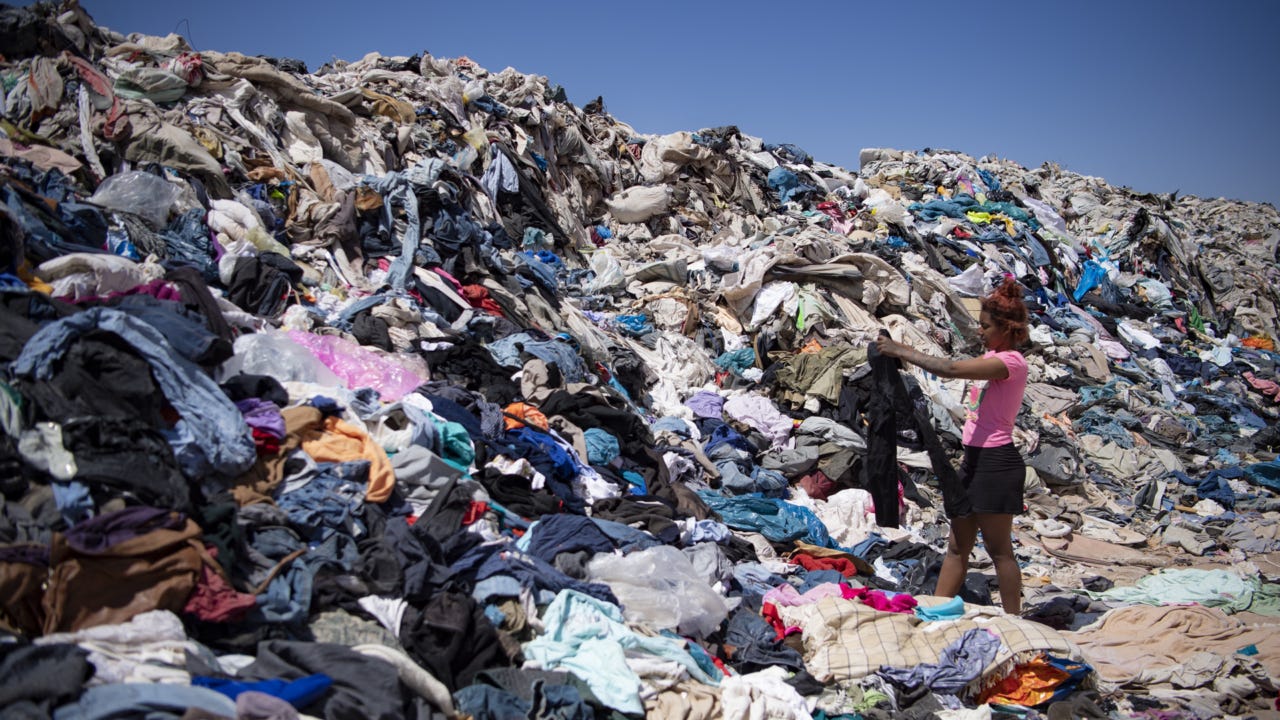
“General overproduction would take place... not because relatively too little had been produced of the commodities consumed by the workers or too little of those consumed by the capitalists, but because too much of both had been produced – not too much for consumption, but too much to retain the correct relation between consumption and realization; too much for realization.”
During Marx’s time, economists argued that during capitalist crises no actual wealth was destroyed. Marx countered this by showing that, in fact, while price may hide the illusion, because commodities sit and are unable to be realized onto the market, the value contained within them is actually destroyed, and total social capital as a result does get destroyed.
“in a crisis... there occurs a general devaluation or destruction of capital... extending even to living labour capacity itself. The destruction of value takes place not by a real increase of productive force, but by a decrease in the existing value of raw materials, machines, and labour capacity—resolving into a real decrease in production to restore the correct relation between necessary and surplus labour. ”
Crises benefit capital by decreasing the cost of labor power (as workers are made unemployed en masse and therefore rendered more desperate), devaluing the means of production en masse as they are forced to be sold well below their value in conditions where production halts, and allowing the right amount of commodity output to be re-established at rates between necessary labor and surplus where commodities produced can realize their value on the market again.
“The other side of the crisis resolves itself into a real decrease in production, in living labour – in order to restore the correct relation between necessary and surplus labour, on which, in the last analysis, everything rests.“
When looking at capital during its first cycle, many inputs appear independent (M-C…P…C’–M’). However, during its second cycle, capital is able to take ownership of its entire menagerie of inputs (M’–C…P…C’’–M’‘).
Non-objectified living labor in the second cycle confronts living labor as objectified value; the past labor of workers in the previous cycle now creates the value of their own pay for the next cycle of workers’ wages. Their past labor (or the labor of other workers) returns objectified into machines and the means of production. Finally, labor confronts itself as alienated from itself: workers are paying their own future wages in the next cycle, and yet are alienated from their very labor and the product of that labor as it is objectified into the capital around them and into their own wages. Labor is constantly made to structurally forget itself as the source of value.
“All moments which confronted living labour capacity... as alien, external powers... are now posited as its own product and result. Firstly: surplus value... [is] nothing but a specific sum of objectified living labour... Secondly: the particular forms which this value must adopt in order to... posit itself as capital—on one side as raw material and instrument, on the other as subsistence goods... are likewise, therefore, only particular forms of surplus labour itself... Thirdly: The independent, for-itself existence of value vis-à-vis living labour capacity... this absolute separation between property and labour... now likewise appears as a product of labour itself... ”
“All this arose from the act of exchange, in which he exchanged his living labour capacity for an amount of objectified labour, except that this objectified labour - these external conditions of his being, and the independent externality [Ausserihmsein] (to him) of these objective conditions now appear as posited by himself, as his own product, as his own self-objectification as well as the objectification of himself as a power independent of himself, which moreover rules over him, rules over him through his own actions.”
“The product of labour appears as alien property, as a mode of existence confronting living labour as independent, as value in its being for itself; the product of labour, objectified labour, has been endowed by living labour with a soul of its own, and establishes itself opposite living labour as an alien power: both these situations are themselves the product of labour…living labour therefore now appears from its own standpoint as acting within the production process in such a way that, as it realizes itself in the objective conditions, it simultaneously repulses this realization from itself as an alien reality, and hence posits itself as insubstantial, as mere penurious labour capacity in face of this reality alienated [entfremdet] from it, belonging not to it but to others; that it posits its own reality not as a being for it, but merely as a being for others, and hence also as mere other-being [Anderssein], or being of another opposite itself. ”
Capitalists in cycle 2 no longer have to pay out-of-pocket for everything, as their capital becomes a self-expanding machine; the surplus from cycle 1 of M-C…P…C’–M’ now pays for buying more workers and the means of production.
“The previous appropriation of alien labour now appears as the simple precondition for the new appropriation of alien labour; or, his ownership of alien labour in objective (material) form, in the form of existing values, appears as the condition of his ability to appropriate new alien living labour capacity, hence surplus labour, labour without equivalent.”
“Property - previous, or objectified, alien labour - appears as the only condition for further appropriation of present or living alien labour.”
The capitalist acts as appropriated alien labor.
PP Opinion: Alienation is not an ideological concept, but material. It is manifested in the objectification of a worker’s labor within the commodity, money, and means of production—his own labor confronting him as an alien force every day. The capitalist embodies this process of objectification and alienation. Under socialism, with the end of the value form and humanity seizing production for itself rather than for a class, human labor stops being alien as people become the democratic determinants of what happens with their labor.
“the capitalist represents value for- itself, money in its third moment, wealth, by means of simple appropriation of alien labour; since every moment of surplus capital, material, instrument, necessaries, resolves into alien labour, which the capitalist does not appropriate by means of exchange for existing values, but has appropriated without exchange”
Both classes therefore reproduce each other, especially as capital grows through its self-expanding cycles:
“And more particularly, within this process the worker produces himself as labour capacity, as well as the capital confronting him, while at the same time the capitalist produces himself as capital as well as the living labour capacity confronting him. Each reproduces itself, by reproducing its other, its negation. The capitalist produces labour as alien; labour produces the product as alien. The capitalist produces the worker, and the worker the capitalist etc.”
“The material on which it works is alien material; the instrument is likewise an alien instrument; its labour appears as a mere accessory to their substance and hence objectifies itself in things not belonging to it. Indeed, living labour itself appears as alien vis-à-vis living labour capacity, whose labour it is, whose own life’s expression [Lebensäusserung] it is, for it has been surrendered to capital in exchange for objectified labour, for the product of labour itself. Labour capacity relates to its labour as to an alien, and if capital were willing to pay it without making it labour it would enter the bargain with pleasure.Thus labour capacity’s own labour is as alien to it - and it really is, as regards its direction etc. - as are material and instrument.”
“Wage labour, here, in the strict economic sense in which we use it here, and no other... is capital-positing, capital-producing labour, i.e. living labour which produces both the objective conditions of its realization as an activity, as well as the objective moments of its being as labour capacity, and produces them as alien powers opposite itself, as values for- themselves, independent of it”
If the worker reproduces capital, then they as a class can just as easily stop this reproduction through the withholding of their labor.
Capital throughout its life cycles transforms from small capital—wherein its original ideals of capitalists putting in hard work and elbow grease to become rich are celebrated—into a beast of accumulation and hoarding of labor power and the means of production in endless self-expansion. This new form of capital is then given apologetics by economists.
“Therefore, the conditions which... express the becoming of capital do not fall into the sphere of that mode of production for which capital serves as the presupposition; as the historic preludes of its becoming, they lie behind it, just as the processes by means of which the earth made the transition from a liquid sea of fire... now lie beyond its life as finished earth... The bourgeois economists who regard capital as an eternal and natural... form of production then attempt at the same time to legitimize it again by formulating the conditions of its becoming as the conditions of its contemporary realization...”
Capital presupposes that serfdom and slavery have been abolished; a worker is free labor, able to exchange his labor power with whoever he sees fit.
“In the serf relation he appears as a moment of property in land itself, is an appendage of the soil, exactly like draught -cattle. In the slave relation the worker is nothing but a living labour -machine, which therefore has a value for others, or rather is a value. The totality of the free worker’s labour capacity appears to him as his property, as one of his moments, over which he, as subject, exercises domination, and which he maintains by expending it. This to be developed later under wage labour.”
But a free laborer is not enough for capital to exist—after all, a king’s servants were also free labor under previous modes of production.
Productive vs. Unproductive Labor & Value Creation
Marx distinguishes productive and unproductive labor:
Productive labor creates the self-expansion of value; a worker generates capital that is able to hire more workers and buy more means of production.
Unproductive labor consumes revenue. When a capitalist hires a cook, lawyer, or maid, they do not create more cooks, lawyers, or maids for capital; rather, a service is simply performed.
A doctor in a nationalized hospital absorbs surplus value redistributed by the state; he does not generate value to hire more doctors. Conversely, a doctor in a private company creates value that is able to hire new doctors, nurses, and buy new hospital buildings.
“In the exchange of capital for labour, value is not a measure of the exchange of two use values, but is rather the content of the exchange itself.”
Historical Preconditions & Separation of Labor from Property
Capital’s real distinction from other modes of production is that labor is alienated from the worker, objectified, and used as a tool of social control over more workers (and means of production) every single cycle, with the entirety of the working class turned into a single social pool of control and reduced to appendages of machines.
“The machinery, of fixed capital... as animated monster, objectifies the scientific idea... does not in any way relate to the individual worker as his instrument; but rather he himself exists as an animated individual punctuation mark; as its living isolated accessory.”
“Capital therefore is the existence of social labour the combination of labour as subject as well as object but this existence as itself existing independently opposite its real moments - hence itself a particular existence apart from them. For its part, capital therefore appears as the predominant subject and owner of alien labour, and its relation is itself as complete a contradiction as is that of wage labour”
In previous modes of production, property was communal, and things were produced primarily for use value. In order for capital to be created, peasants had to be stripped of land and therefore forced to sell their only remaining property: their labor power (the ability to do work). Capital, therefore, is a historically created mode of production.
“The commune, although already a product of history here, not only in fact but also known as such, and therefore possessing an origin, is the presupposition of property in land and soil - i.e. of the relation of the working subject to the natural presuppositions of labour as belonging to him - but this belonging [ is ] mediated by his being a member of the state, by the being of the state - hence by a presupposition regarded as divine etc.”
“The positing of the individual as a worker, in this nakedness, is itself a product of history.”
PP Opinion: Prior economies did not allow humanity to realize a universal totality, as the economy was heavily fractured. Classes in and of themselves were not able to realize their own existence due to this fracturing. What makes capital special is that it achieves a universal totality through its world market and the reduction of labor to an abstract category exchangeable for money. By doing so, it breaks all barriers into a world market and allows a class to realize itself as a class through worldwide struggle within the system of class society—something that could not be done in previous, atomized economic modes of production.
“The economic totality is, at bottom, contained in each individual household, which forms an independent centre of production for itself ( manufactures purely as domestic secondary task for women etc. ). In the world of antiquity, the city with its territory is the economic totality; in the Germanic world, the totality is the individual residence, which itself appears as only a small dot on the land belonging to it, and which is not a concentration of many proprietors, but the family as independent unit…communal property as such appears only as a communal accessory to the individual tribal seats and the land they appropriate. The commune is neither the substance of which the individual appears as a mere accident; nor is it a generality with a being and unity as such [seiende Einheit] either in the mind and in the existence of the city and of its civic needs as distinct from those of the individual, or in its civic land and soil as its particular presence as distinct from the particular economic presence of the commune member; rather, the commune, on the one side, is presupposed in-itself prior to the individual proprietors as a communality of language, blood etc.,”
Speaking of ancient economies:
“But there can be no conception here of a free and full development either of the individual or of the society, since such development stands in contradiction to the original relation”
“Thus the old view, in which the human being appears as the aim of production, regardless of his limited national, religious, political character, seems to be very lofty when contrasted to the modern world, where production appears as the aim of mankind and wealth as the aim of production. In fact, however, when the limited bourgeois form is stripped away, what is wealth other than the universality of individual needs, capacities, pleasures, productive forces etc., created through universal exchange? The full development of human mastery over the forces of nature, those of so-called nature as well as of humanity’s own nature? The absolute working-out of his creative potentialities, with no presupposition other than the previous historic development, which makes this totality of development, i.e. the development of all human powers as such the end in itself, not as measured on a predetermined yardstick? Where he does not reproduce himself in one specificity, but produces his totality? Strives not to remain something he has become, but is in the absolute movement of becoming? In bourgeois economics - and in the epoch of production to which it corresponds this complete working -out of the human content appears as a complete emptying-out, this universal objectification as total alienation, and the tearing-down of all limited, one- sided aims as sacrifice of the human end -in- itself to an entirely external end. This is why the childish world of antiquity appears on one side as loftier. On the other side, it really is loftier in all matters where closed shapes, forms and given limits are sought for. It is satisfaction from a limited standpoint; while the modern gives no satisfaction; or, where it appears satisfied with itself, it is vulgar. ”
“For the encounter with the objective conditions of labour as separate from him, as capital from the worker’s side, and the encounter with the worker as propertyless, as an abstract worker from the capitalist’s side - the exchange such as takes place between value and living labour, presupposes a historic process”
Property, Marx points out, was originally simply man’s relationship with nature and their actions in the self-reproduction of their societies; man and property were naturally wed. Slaves and serfs were treated as part of the soil itself. In order for the capital relation to be established, property had to be divorced from labor itself into two separate categories, with human beings coming to own nothing but their own ability to do labor, thus becoming the proletariat.
“It is not the unity of living and active humanity with the natural, inorganic conditions of their metabolic exchange with nature... which requires explanation... but rather the separation between these inorganic conditions of human existence and this active existence, a separation which is completely posited only in the relation of wage labour and capital.”
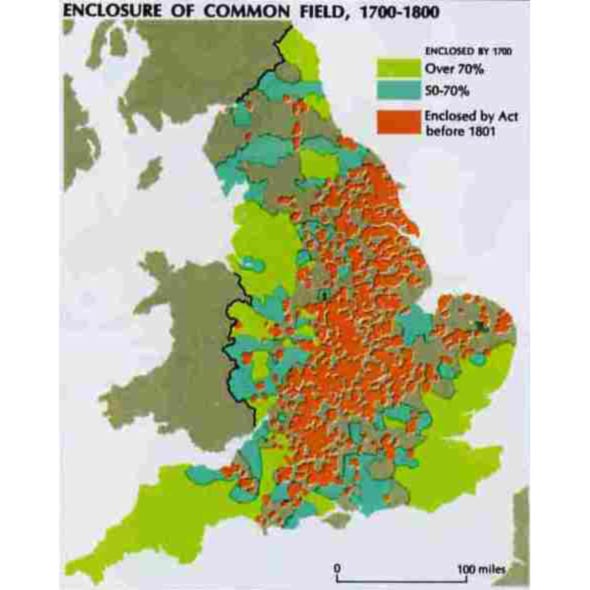
Historical Preconditions of Property and Labor [Notebook IV-V pp. 397-438]
“The real appropriation takes place not in the mental but in the real, active relation to these conditions - in their real positing as the conditions of his subjective activity.”
“The aim of all these communities is survival; i.e. reproduction of the individuals who compose it as proprietors... This reproduction, however, is at the same time necessarily new production and destruction of the old form.”
“Where there is already a separation between the commune members as private proprietors... and they themselves as the urban commune and proprietors of the commune’s territorium... there the conditions already arise in which the individual can lose his property, i.e. the double relation which makes him both an equal citizen, a member of the community, and a proprietor”
What creates the historical individual and capital relation out of the ancient communal structure in which the individual does not really exist?
“(1) Dissolution of the relation to the earth - land and soil - as natural condition of production to which he relates as to his own inorganic being; the workshop of his forces, and the domain of his will…(2 ) Dissolution of the relations in which he appears as proprietor of the instrument... (4 ) Dissolution likewise at the same time of the relations in which the workers themselves, the living labour capacities themselves, still belong directly among the objective conditions of production, and are appropriated as such i.e. are slaves or serfs. For capital, the worker is not a condition of production, only work is. If it can make machines do it, or even water, air, so much the better. And it does not appropriate the worker, but his labour - not directly, but mediated through exchange…These are, now, on one side, historic presuppositions needed before the worker can be found as a free worker, as objectless, purely subjective labour capacity confronting the objective conditions of production as his not-property, as alien property, as value for- itself, as capital.”
“Human beings become individuals only through the process of history. He originally appears as a species-being, clan being, herd animal... In bourgeois society, the worker... stands there purely without objectivity... but the thing which stands opposite him has now become the true community, which he tries to make a meal of, and which makes a meal of him.”
The master-slave dynamic of previous modes of production created its own downfall; under capital, that relation still exists in the form of the worker selling his labor power and the capitalist buying it, and likewise ‘ferments’ its own downfall.
“This much can be seen here, however, that the master-servant relation likewise belongs in this formula of the appropriation of the instruments of production; and it forms a necessary ferment for the development and the decline and fall of all original relations of property and of production... Still, it is reproduced in mediated form in capital, and thus likewise forms a ferment of its dissolution and is an emblem of its limitation”
Marx on the historical process that created capital:
“Such historic processes of dissolution are also the dissolution of the bondage relations which fetter the worker to land and soil... dissolution of the guild relations... likewise dissolution of the client- relations... The historic process was the divorce of elements which up until then were bound together; its result is therefore not that one of the elements disappears, but that each of them appears in a negative relation to the other—the ( potentially ) free worker on the one side, capital ( potentially ) on the other. The separation of the objective conditions from the classes which have become transformed into free workers necessarily also appears at the same time as the achievement of independence by these same conditions at the opposite pole... Once capital and wage labour are posited as their own presupposition... the worker constantly creates a double fund for the capitalist, or in the form of capital. One part of this fund constantly fulfils the conditions of his own existence and the other part fulfils the conditions for the existence of capital.”
Marx on historical determinism:
“But the mere presence of monetary wealth, and even the achievement of a kind of supremacy on its part, is in no way sufficient for this dissolution into capital to happen. Or else ancient Rome, Byzantium etc. would have ended their history with free labour and capital... There, too, the dissolution of the old property relations was bound up with development of monetary wealth... But instead of leading to industry, this dissolution led in fact to the supremacy of the countryside over the city”
What creates capital:
“Rather, its original formation is that, through the historic process of the dissolution of the old mode of production, value existing as money-wealth is enabled, on one side, to buy the objective conditions of labour; on the other side, to exchange money for the living labour of the workers who have been set free. All these moments are present; their divorce is itself a historic process, a process of dissolution, and it is the latter which enables money to transform itself into capital.”
Marx on primitive accumulation and the closing of the commons:
“Then, firstly, a mass of living labour powers was thereby thrown onto the labour market, a mass which was free in a double sense, free from the old relations of clientship, bondage and servitude, and secondly free of all belongings and possessions, and of every objective, material form of being, free of all property; dependent on the sale of its labour capacity or on begging, vagabondage and robbery as its only source of income... Capital proper does nothing but bring together the mass of hands and instruments which it finds on hand. It agglomerates them under its command.”
Marx summarizing his thoughts on what makes capital as a final product of history:
“Production based on exchange value and the community based on the exchange of these exchange values... all presuppose and produce the separation of labour from its objective conditions. This exchange of equivalents proceeds; it is only the surface layer of a production which rests on the appropriation of alien labour without exchange, but with the semblance of exchange. This system of exchange rests on capital as its foundation, and, when it is regarded in isolation from capital, as it appears on the surface, as an independent system, then it is a mere illusion, but a necessary illusion. Thus there is no longer any ground for astonishment that the system of exchange values—exchange of equivalents measured through labour—turns into, or rather reveals as its hidden background, the appropriation of alien labour without exchange, complete separation of labour and property.”
Capital destroys all old modes of production. It conquers them under its social relation, subordinates them in which labor is separated from property and made propertyless—free labor, only able to sell its labor power in exchange for a wage.
“While, as we have seen, the transformation of money into capital presupposes a historic process which divorces the objective conditions of labour from the worker and makes them independent of him, it is at the same time the effect of capital and of its process, once arisen, to conquer all of production and to develop and complete the divorce between labour and property... Exchange of labour for labour rests on the worker’s propertylessness”
“The circulation of capital constantly ignites itself anew, divides into its different moments, and is a perpetuum mobile.”
Capital’s turnover determines how much surplus value it is able to realize in a year; the circulation of capital is a moment of production itself, as the commodity capital has to realize itself on the market.
“If we examine the entire turnover of capital, then four moments appear... circulation is itself a moment of production, since capital becomes capital only through circulation; production is a moment of circulation only in so far as the latter is itself regarded as the totality... The moments are: (I) The real production process and its duration. (II) Transformation of the product into money... (III) Transformation of the money... into the elements of productive capital. (IV) The exchange of a part of the capital for living labour capacity.”
Transportation is productive labor, not unproductive, as the transport worker’s labor is captured within the commodity. The socially necessary labor time of transportation leads to labor hours taken during transport increasing the value of the commodity and thus being congealed within it. Their work done during (...P…) is also essential to help bring the commodity to the consumer and realize its value.
“Now the question is initially this: ...can a surplus value be extracted from the transport costs? ...If the sailor, the carter etc. require only half a year of labour time to live a full year... then the capitalist employs him for a whole year and pays him a half. By adding a whole year’s labour time to the value of the transported products, but paying only 1/2, he gains a surplus value... The case is entirely the same as in direct production”
Capital needs things like roads, however, individual capitalists will not or cannot pay for them. The state then begins acting as a collective capitalist to manage the general conditions of production in order to absorb costs individual capitalists pay. The state, acting as the collective capitalist, can take on the risk individual capital cannot; therefore, in mature capitalist countries the state is subordinated to capital’s needs and its public works serve them, while in immature capitalist countries the state asks capital to pay for these public works.
“Capital shifts the burden on to the shoulders of the state... so long as capital does not adopt the form of the joint-stock company, it always looks out only for its particular conditions of realization, and shifts the communal conditions off on to the whole country as national requirements... The highest development of capital exists when the general conditions of the process of social production are not paid out of... the state’s taxes... but rather out of capital as capital”
“All general, communal conditions of production so long as their production cannot yet be accomplished by capital as such and under its conditions are therefore paid for out of a part of the country’s revenue... and the workers do not appear as productive workers, even though they increase the productive force of capital”
Capital’s cycle is also spatial and temporal—the time and distance it takes for a commodity to realize itself after production on the market either devalues it (sitting around rotting) or helps it realize value faster (faster shipping and buyers). Because of this temporal waiting time in between production and selling, credit is created in order to allow capital to start production immediately without having to wait for all commodities to be sold. Credit is a unique moment that exists truly in capital, whereas before it was used to collect from individuals, now it is essential to the production process itself.
“Which is why credit in any developed form appears in no earlier mode of production. There was borrowing and lending in earlier situations as well, and usury is even the oldest of the antediluvian forms of capital. But borrowing and lending no more constitute credit than working constitutes industrial labour or free wage labour. And credit as an essential, developed relation of production appears historically only in circulation based on capital or on wage labour.”
Capital acts as a shell that wraps itself in different cloth around value as it transforms into money, labor and means of production, commodity capital, and then money again.
PP Opinion: Capital not only acts as a shell around the capital process M-C(Labor Power + m.o.p.)...P…C’–M’, but also politically, as it takes on many faces of rule (liberal, fascist, even aesthetically Marxist) in order to preserve its true form in political economy. What are social democracy and fascism then? There are several answers, but as parts within the totality, they represent capital attempting to avoid its crisis of overproduction through the state.
“Capital is now posited... as realizing itself as value, as value relating to itself as value in every one of the moments of its metamorphosis... Capital is thus posited as value-in-process…”
Capital is driven to limit turnover, transportation time, and to conquer every market in order to realize its value. Think of how easy things are to buy in the modern world of smartphones with as little friction as possible, featuring next-day delivery and the like.
“Thus, while capital must on one side strive to tear down every spatial barrier to intercourse... and conquer the whole earth for its market, it strives on the other side to annihilate this space with time.”
Capital must constantly strive through its cycles to ‘beat itself’. In doing so, it squeezes its major source of value—labor—out of the process as technical and scientific breakthroughs reduce necessary labor within the process; it eats itself.
Capital’s Contradictions, Crisis, and Historical Transition
“Capital posits the production of wealth itself and hence the universal development of the productive forces, the constant overthrow of its prevailing presuppositions, as the presupposition of its reproduction... It thus becomes the presupposition of a new mode of production... a mere point of transition.”
Marx on human development and scientific ingenuity:
“The development of science alone - i.e. the most solid form of wealth, both its product and its producer - was sufficient to dissolve these communities. But the development of science, this ideal and at the same time practical wealth, is only one aspect, one form in which the development of the human productive forces, i.e. of wealth, appears. Considered ideally, the dissolution of a given form of consciousness sufficed to kill a whole epoch. In reality, this barrier to consciousness corresponds to a definite degree of development of the forces of material production and hence of wealth.”
Circulation does not create value for capital; rather, it is a barrier to capital realizing its value.
“Circulation time in itself is not a productive force of capital, but a barrier to its productive force arising from its nature as exchange value”
The market always balances itself toward an equalization in rates of profit. Capitals that have lower turnover end up charging a price above true value, while capitals that have higher turnover charge a price below true value. As a result, all surplus value produced by the production process is pooled by capitalists and distributed based on the amount of capital investment. Thus, value is transferred from capitals with a lower organic composition to those with a higher one as a result of competition itself (capital flooding industries with higher rates of profit draws prices below value and aids capital with lower rates of profit).
“But the sum of the surplus value created by all these capitals together would be lessened exactly by the amount of capital A’s lesser realization in relation to the other capitals; only, instead of this reduction falling exclusively on capital A, it is borne as a general loss, as a loss shared proportionally by all the capitals”
Competition and the Equalization of Profit
Competition is an expression of capital’s underlying laws—namely, the equalization of rates of profit. It does not create these laws, but rather emerges from them.
“Competition generally, this essential locomotive force of the bourgeois economy, does not establish its laws, but is rather their executor... Competition therefore does not explain these laws; rather, it lets them be seen, but does not produce them”
Though wage labor is treated as an equal exchange between labor and capital, it is in reality a crystallization of surplus labor into a commodity. Therefore, it is not equal; capital gets more out of the contract than labor, which only receives back its necessary labor (the value of which it produced itself).
“the power to appropriate alien labor without exchange, without equivalent, but with the semblance of exchange.”
Marx dismantled Ricardo’s idea that rates of profit fell due to agricultural soil losing nutrients, pointing out instead that:
“The rate of profit is not the same as the absolute surplus value, but is rather the surplus value in relation to the capital employed... when the relation between total labour and the capital which employs it falls, then the part of labour which appears as surplus labour or surplus value necessarily falls too”
Ricardo also assumed that labor was bought at the full value which it produced, which would mean zero profit. Marx corrected this by pointing out that what is bought is not labor itself, but the ability to do labor (labor power), which is paid at a rate less than what labor produces in value throughout a day.
“What the capitalist acquires through exchange is labour capacity: this is the exchange value which he pays for. Living labour is the use value which this exchange value has for him, and out of this use value springs the surplus value.”
Bourgeois economists hide the true source of value (labor) in their calculations, and an increase in automation does not give the working class more free time or make them richer (or turn them into capitalists themselves). Rather, the saved time in production is a detriment to them, as it is used to throw a section of the working class into unemployment and exploit the remainder more intensively.
“In order to determine the size of the real surplus value, one must calculate the profit on the advance made for wages... Value of labour presupposes in principle that living labour is not equal to its product... The growth of the productive forces expresses itself in a continuous decline of the part of capital consisting of labour compared with that laid out in advances, machinery etc.... Such is the logic of Mr Carey, the harmonizer.”
Money’s role within capital is twofold: as a realization of surplus value through the commodity, and as a medium of circulation to pay wages and buy means of production. During capitalist crises, capitalists will often scream that there is not enough money and that more needs to be printed. However, the issue is not a lack of money itself, but rather that capital lacks value that is able to be realized on the market.
“In the circulation of capital, money appears doubly... Now the fact that money plays this double role in the circulation of capital makes it appear in all crises as if money were lacking as medium of circulation, whereas capital lacks value and hence cannot monetize itself.”
Capital brings many workers together into cooperation (socialized labor), but as a force standing outside of them. Since this cooperation is neither their own choice nor determined by them, their socialized labor becomes an external force turned against them.
It also changes the economy from people bartering with each other to a mass of workers all selling their labor power to a handful of capitalists.
“He relates to his own combination and cooperation with other workers as alien, as modes of capital’s effectiveness”
“All social powers of production are productive powers of capital, and it appears as itself their subject. The association of the workers... is therefore not posited by them but by capital. Their combination is not their being, but the being of capital.”
“Instead of exchanging with many, they [PP: workers] exchange only with the one capitalist.”
“But this presupposes the ( preliminary ) gathering -together of many workers under a single command, just as the process through which money becomes capital presupposes the previous liberation of a certain amount of necessaries of life, raw materials and instruments of labour.”
Marx’s favorite example of how a quantitative (numerical) shift in workers can create a qualitative (change in) social relations is always that of a farmer and a worker:
Imagine there’s one farmer and one worker; both the farmer and worker have to tend to the fields to be able to socially reproduce themselves. Is the farmer a capitalist yet? No.
Imagine that the farmer then gains 10 workers; suddenly he is able to not only wholly live off the surplus of his workers without having to work himself, but is also able to buy more farmland and workers the next year. Has the farmer become a capitalist? Yes.
“Thus, in order that money may become transformed into capital, it is necessary not only that it should be able to set surplus labour in motion, but also that there should be a certain quantity of surplus labour”
Capital is a unique economic system because it takes human progress (science, political development, art, historical development) that had before been usually out of reach from most people, and turns it into a generating source of wealth.
“only capital has subjugated historical progress to the service of wealth.”
Coerced labor in capital isn’t done through physical force, but rather the fact that all property needed to socially reproduce human society (tools, raw materials, machines) is alien property to labor (not owned by it), so that workers, in order to reproduce themselves, must sell their labor power to work on these things.
“Under capital, the association of workers is not compelled through direct physical force, forced labour, statute labour, slave labour; it is compelled by the fact that the conditions of production are alien property and are themselves present as objective association, which is the same as accumulation and concentration of the conditions of production.”
Marx on how bourgeois economists often forget about the other side of class society:
“it is nonsensical, therefore, for him to speak of capitalists without wage labourers…Labour appears as the instrument of the production of value because it is not paid for, hence not represented by wages [PP: Surplus labor]. As the activity which creates use values, it likewise has nothing to do with itself as paid labour. In the hand of the worker, the wage is no longer a wage, but a consumption fund. It is wages only in the hand of the capitalist, i.e. the part of capital destined to be exchanged for labour capacity. It has reproduced a saleable labour capacity for the capitalist, so that in this regard even the worker’s consumption takes place in the service of the capitalist”
The working class themselves becomes over time aware of how their surplus labor is being captured by the net of capital as opposed to what is given to them for wages:
“In the struggle between the two classes... the measurement of the distance between them, which, precisely, is expressed by wages itself as a proportion, becomes decisively important. The semblance of exchange vanishes... the worker receives as wages from the capitalist what is only a part of his own labour.”
Over time, through relative surplus value mechanisms, capital is able to capture more of a worker’s labor into surplus within the commodity than within their pay.
“It is the pith of all value-creation and of capital-creation that objectified working days command a greater number of living ones.”
Marx asserts that relative surplus value only goes up if the production of bare essential commodities for the working class is cheapened (food, housing, etc.), as creating more luxury items like cashmere sweaters would not decrease necessary labor costs for capital whatsoever.
“Relative surplus value [is] obviously restricted not only by the relation cited earlier, but also by the degree to which the product enters into the worker’s consumption. If the capitalist could obtain twice the number of cashmere shawls...”
The ‘setting free’ of necessary labor, however, also creates a surplus population as fewer workers are needed each cycle.
“Since it is further the condition of production based on capital that he produces ever more surplus labour, it follows that ever more necessary labour is set free. Thus the chances of his pauperism increase.”
The creation of this surplus population as a result of this change in composition between machine and man is unique to capital, as labor power is made more productive and the working class’s own non-objectified labor is objectified in the machines around it.
Most importantly, Malthusian ‘overpopulation’ is actually a socially created relation by capital, not a law of nature.
“Only in the mode of production based on capital does pauperism appear as the result of labour itself, of the development of the productive force of labour.”
PP Opinion: The sole purpose of capital is realizing exchange value, not the use of commodities itself. If something is not profitable (for example, homeless people cannot buy homes), it does not seek to mediate this issue; something must generate the continual self-expansion of capital in order for it to be considered.
“The aim of producing capital is never use value, but rather the general form of wealth as wealth... The great object of the monied capitalist, in fact, is to add to the nominal amount of his fortune. It is that, if expressed pecuniarily this year by £20,000 e.g., it should be expressed pecuniarily next year by £24,000... Commodities [are] thus not the terminating object of the trading capitalist.”
With a growing surplus population, there is always a section of it which is able to work or seeking work (the reserve army of labor) which corresponds to surplus capital that is generated and therefore can re-enter production, having the effect of driving down wages.
“At the same time, capital has the tendency both to posit and equally to suspend this pauperism, because it constantly reproduces itself as surplus capital…(2 ) it requires a part of the population which is unemployed ( at least relatively ); i.e. a relative surplus population, in order to find the readily available population for the growth of surplus capital”
Landlords, capitalists, etc., are also a surplus population, as they are not the ones who produce new value within capital:
“The further development of capital shows that besides the industrial part of this surplus population - the industrial capitalist - a purely consuming part branches off: idlers, whose business it is to consume alien products and who, since crude consumption has its limits, must have the products furnished to them partly in refined form, as luxury products.”
The capitalist mode of production has many gaps within it wherein value is not immediately realized. In ancient economies such as barter, things were awkward but simple: I have an item, my neighbor has one, and we exchange equivalents (C–C), though it may take me weeks to produce an item my neighbor can in a day. With the introduction and victory of the money form and complex production, however, there are large gaps where items or money just sit there (M–C…P…C’–M’).
It takes time to buy workers and means of production, it takes time to produce, and it takes time to transport and sell commodities. Credit is then needed to fill this gap in time.
“The difference of time required to complete the products of agriculture, and of other species of labour, is the main cause of the great dependence of the agriculturists... For that whole period they are obliged to borrow from the shoemaker, the tailor, the smith”
Going back to simple exchange, if I wanted to give my neighbor something that I couldn’t immediately produce (e.g., “I will give you wheat once it’s done growing for your sword”), I would need something to temporally measure our exchange and the values contained within both. Out of this comes what birthed money (C–M–C).
Marx’s Views On Labor
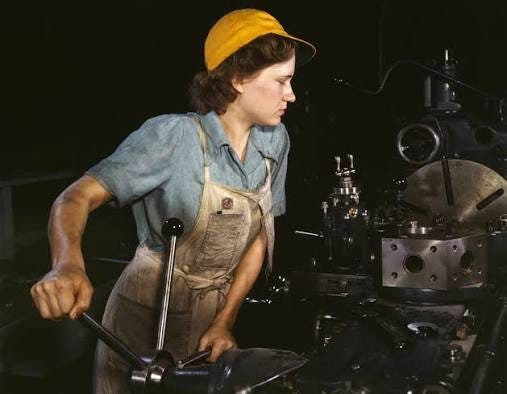
Through a critique of Adam Smith, Marx reveals his foundational views on labor. While Adam Smith saw labor purely as a sacrifice of one’s freedom, happiness, and tranquility, Marx pushed back against this conception:
“But it is something else, too, in addition to this emotional relation with his activity—firstly, for others, since A’s mere sacrifice would be of no use for B; secondly, a definite relation by his own self to the thing he works on, and to his own working capabilities. It is a positive, creative activity”
While coerced labor within class society—alienated labor—is inherently miserable and torturous, Marx argues that labor itself is not a negative. Rather, it is a fundamentally positive, creative activity: the exertion of human muscle, brain, and will onto an object, transforming the world around us. Stripped of class society and coerced relations, labor ceases to be a burden and instead becomes the true realm of human freedom, wherein man shapes nature and the world to his own conscious will.
Turnover
The turnover of capital is the process by which capital brings its commodities to market, realizes its value, and reinvests to expand M-C (LP+m.o.p.)...P…C’-M’-C…P…C’’-M’’. Capital is fundamentally driven to accelerate this turnover. However structural gaps (...) exist between purchasing labor power and the means of production, completing production, and waiting for commodities to reach the market and find a buyer.
“The more rapid the circulation, the shorter the circulation time, the more often can the same capital repeat the production process”
Capital’s ultimate goal is to compress circulation time as close to zero as possible to achieve the fastest possible turnover. Yet, commodities frequently sit unsold. Because of this structural layout, a portion of capital is perpetually locked up: capitalists must sink funds into fixed capital (machinery and factories) and maintain commodity capital that sits idle while waiting for buyers. Production must occur before buyers are physically present to purchase the goods.
“every capital is circulating capital... Capital as the unity of circulation and production is at the same time the division between them, and a division whose aspects are separated in space and time, at that…The part moving [prozessierend] within production is then the circulating part; the part in circulation is the immobilized part.”
PP Opinion: This structural immobilization is precisely what Keynesianism attempted to resolve through state intervention, taxation, and deficit spending (borrowing against future value production) to act as an artificial buyer of last resort. This was a post-WWII strategy deployed to stave off capitalist crises of overproduction. However, that crisis caught up with the system in 2008, and the world has been paying the price ever since through the long-term stagnation and structural decline of the global capitalist economy.
“‘This constant non-employment of a large part of capital is the price we pay for the division of labour. The purchase is worth what it costs; but the price is considerable’ [Marx quoting economist Samuel Bailey]”
“Therefore, capital in each of its particular phases is the negation of itself as the subject of all the various metamorphoses”
“it is a condition of capital that part of it always lies fallow. This takes the visible form that a part of the national capital is always stuck in one of the phases through which capital has to move”
The Function of Credit and Circulation Costs [Notebook VI pp. 547-558, 590-600]
This temporal and spatial friction is precisely where credit emerges as an indispensable tool:
“credit likewise suspends these barriers to the realization of capital only by raising them to their most general form, positing one period of overproduction and one of underproduction as two periods”
The costs associated with circulation—such as purchasing logistics, legal fees, and bookkeeping—are entirely unproductive. They do not generate a single atom of value; they merely consume time and resources in the attempt to realize the value already created during production by living labor.
“The costs of circulation as such do not posit value, they are costs of the realization of values”
Consequently, the so-called “labor” performed by the capitalist within circulation does not create value. It may facilitate the transfer or realization of ownership titles, but viewing the capitalist’s time as value-creating is a total illusion.
“To regard the time the capitalist spends in circulation as value-creating time or even surplus-value-creating time is to fall into the greatest confusion. Capital as such has no labour time apart from its production time. The capitalist absolutely does not concern us here except as capital. And he functions as such only in the total process we are examining. Otherwise, it could still be imagined that the capitalist draws compensation for the time during which he does not earn money as another capitalist’s wage labourer – or that he loses this time.”
Artificial Circulation and Effects of Long Circulation Time [Notebook VI pp. 558-563]
Circulation is not solely used to realize the value generated during production; it can also be conducted “artificially” or speculatively. To illustrate this, Marx references how merchants in Russia would repeatedly trade the exact same commodities back and forth among themselves, driving up nominal prices without a single atom of net wealth being added. This phenomenon starkly demonstrates that circulation does not create value—only labor does.
“Monstrous quantities of sugar, coffee, hemp, iron etc. rapidly passed from one hand to the other, and a commodity often changed proprietors twenty times, without leaving the warehouse. This kind of circulation offers the dealers all manner of speculative opportunities; but while it enriches some, it ruins the others, and the nation’s wealth gains nothing thereby.” [Marx quoting Heinrich Storch in agreement]
Marx also demonstrates that longer circulation times directly diminish the realization of surplus value. A prolonged circulation period represents a lock-up within the reproduction process, during which commodities sit idle in warehouses and no new value-creating production can occur (this is precisely the structural bottleneck that credit steps in to alleviate).
Because credit temporarily bridges these gaps, it feeds the dangerous illusion among capitalists that capital inherently grows on its own, entirely independent of the messy, concrete realities of labor and production.
“The fact that capital regards itself, and necessarily so, as productive and fruit-bearing independently of labour, assumes itself as fertile at all times, and calculates its circulation time as value-creating time as production cost is quite another thing.”
Further Critique of Prodhoun, Ricardo [ Notebook III-VI]
Proudhon fundamentally misunderstood surplus value, treating it as a transhistorical, eternal feature of all human societies rather than a specific historical product. Marx countered that surplus value is simply the result of a historical development in productivity, where the social capacity to produce outstrips the necessary labor time required for survival. Consequently, the only permanent reality underlying this process is the saving of human labor hours through productivity—a liberation that, under socialism, will be harnessed to return free time to humanity.
“The fact that work goes on beyond necessary labour is transformed by Proudhon into a mystical quality of labour... The only extra-economic fact in this is that the human being does not need his entire time for the production of the necessaries…”
Meanwhile, Ricardo fell into the trap of confusing the physical destruction of an object with the destruction of its value—believing, for instance, that when wheat is ground into flour and baked into bread, the original value of the wheat simply vanishes. Marx recognized instead that value survives the physical transformation of an object, carrying over from the wheat into the bread, and subsequently into money once that bread is sold, metamorphosing continuously across the production, exchange, and circulation process of capital.
Furthermore, while Ricardo attempted to sideline use value as irrelevant to exchange value, he contradicted himself the moment he tried to calculate ground rent based on natural soil fertility. Use value is entirely critical: the material properties of a commodity (such as whether milk spoils rapidly) directly dictate its required circulation time and terms of exchange.
Finally, constant capital (machinery) and raw materials are dead. They do not posit new value; they are merely objectified past labor. Raw materials transfer their pre-existing value entirely to the new product, while machinery passes on its value fractionally as it wears down. But this value was already pre-created. New value is breathed into the process of capital through one thing and one thing only: living labor.
“Capital posits the permanence of value... by incarnating itself in fleeting commodities... changing them just as constantly... But capital obtains this ability only by constantly sucking in living labour as its soul, vampire-like.”
Competition [Notebook VI-VII pp. 572-575, 579-580]
The common bourgeois narrative portrays the triumph of free competition as the ultimate liberation of the individual. Marx completely reversed this formulation: free competition is not the freedom of human beings, but rather the freedom of capital itself, shaking off the archaic, restrictive legal, political, and social barriers of feudalism so it can pursue its self-expansion unhindered.
Rather than liberating people, free competition achieves the exact opposite: the total subordination of the individual to the blind, objective rule of capital.
“Free competition is the relation of capital to itself as another capital, i.e. the real conduct of capital as capital. The inner laws of capital... are for the first time posited as laws... It is not individuals who are set free by free competition; it is, rather, capital which is set free.”
“Hence, on the other side, the insipidity of the view that free competition is the ultimate development of human freedom... It is nothing more than free development on a limited basis - the basis of the rule of capital. This kind of individual freedom is therefore at the same time the most complete suspension of all individual freedom, and the most complete subjugation of individuality under social conditions which assume the form of objective powers, even of overpowering objects of things independent of the relations among individuals themselves.”
“The assertion that free competition = the ultimate form of the development of the forces of production and hence of human freedom means nothing other than that middle-class rule is the culmination of world history - certainly an agreeable thought for the parvenus of the day before yesterday”
The Law of Value, Competition, and Joint-Stock Capital [ Notebook VI-VII pp. 572-580]
As established, the true substance and measure of a commodity’s value is not its physical makeup, but the socially necessary labor time required to reproduce it across an industry.
“The fundamental law in competition... is that it is determined not by the labour contained in it... but rather by the labour time in which it can be produced, or, the labour time necessary for reproduction.”
Because competition and the equalization of profit rates continuously mask this underlying extraction of surplus labor behind fluctuating market prices, the system perpetually hides its own exploitative foundation.
As capital develops, competition among small, direct owners leads to centralization, the rise of credit, and ultimately the formation of the joint-stock corporation. Here, capital reaches its highest institutional maturity, where the actual owners (shareholders) are entirely divorced from the direct management and physical execution of production.
“And the most extreme form to which the suspension proceeds, which is however at the same time the ultimate positing of capital in the form adequate to it - is joint- stock capital”
The Great Inversion: Bourgeois Rights into Prototypical Propertylessness [ Notebook III-IV pp. 382-397, 459-471]
The defining tragedy of the capitalist mode of production is how its foundational premises—enshrined in the formal laws of private property, liberty, equality, and free exchange—inevitably invert into their exact opposites.
When a worker steps onto the market, they appear as a free legal subject trading an equivalent commodity (their labor power) for a wage. But within the production process, that formal equality shatters: the worker sells themselves as a mere effect (a reproducible commodity), while capital absorbs them as a cause (a living, value-generating force). The worker receives back only the past labor time required to sustain their body, while surrendering a vast ocean of unpaid surplus labor.
“The turn into its opposite arises from the fact that the use value of labour capacity, as value, is itself the value-creating force... In this exchange, then, the worker receives the equivalent of the labour time objectified in him, and gives his value-creating, value-increasing living labour time. He sells himself as an effect. He is absorbed into the body of capital as a cause, as activity. Thus the exchange turns into its opposite, and the laws of private property - liberty, equality, property - property in one’s own labour, and free disposition over it - turn into the worker’s propertylessness, and the dispossession [Entäusserung] of his labour, [i.e.] the fact that he relates to it as alien property and vice versa.”
Fixed Capital and the Fetishism of Machinery [Notebook VI-VII pp. 612-636]
Bourgeois economists long maintained that fixed capital (machinery, factories, infrastructure) acts as an independent source of new value. Marx thoroughly demolished this illusion, demonstrating that fixed capital cannot create a single atom of new value. Because machines themselves are products of past human labor, they merely transfer their pre-existing, congealed value fractionally into the final product as they wear down during production.
An increase in the proportion of fixed capital relative to variable capital actually slows down turnover time, because a machine must be utilized over its entire physical lifespan to recover its initial cost. Crucially, capital is driven to automate not to save human labor or grant humanity free time, but solely to cheapen commodities through mass production, capture relative surplus value, and outcompete rivals.
“Fixed capital can enter into circulation as value, however, only to the extent that it passes away as use value in the production process. It passes, as value, into the product... in so far as it passes away in its independent form as use value. In being used, it is used up, but in such a way that its value is carried over from its form into the form of the product. If it is not used... if the machinery stands still, the iron rusts, the wood rots – then of course its value passes away together with its transitory presence as use value... Its total value is completely reproduced, i.e. is fully returned via circulation only when it has been completely consumed as use value in the production process.”
Mainstream economists also argued that replacing human labor with machines inherently generates profit. Marx dismissed this as crude bourgeois ideology. Machines do not spawn value; they merely augment relative surplus value by allowing fewer workers to produce more commodities in less time, thereby shrinking necessary labor. To attribute value-generating powers to inanimate steel and iron is a profound theoretical error:
“The crude materialism of the economists who regard as the natural properties of things what are social relations of production among people, and qualities which things obtain because they are subsumed under these relations, is at the same time just as crude an idealism, even fetishism, since it imputes social relations to things as inherent characteristics, and thus mystifies them.”
Under the capitalist mode of production, industrial machinery forms a vast, self-moving automaton. Instead of serving as an extension of the human artisan, the machine subordinates living labor entirely to its own relentless rhythm.
“In its most rigorous sense, this term [factory] conveys the idea of a vast automaton, composed of numerous mechanical and intellectual organs operating in concert... all these organs being subordinated to a motive force which moves itself.” [Marx quoting Andrew Ure in agreement]
“The worker’s activity, reduced to a mere abstraction of activity, is determined and regulated on all sides by the movement of the machinery, and not the opposite…In machinery, objectified labour confronts living labour within the labour process itself as the power which rules it; a power which, as the appropriation of living labour, is the form of capital.”
Fixed Capital As Alienation [Notebook VII pp. 749-751]
The transformation from tool to fixed capital was a quantitative to qualitative one. At first, capital simply gathered human tools en masse as it built itself up as a relation. However, as its totality expanded to absorb more labor and tools, both were separated, and fixed capital became an alien force confronting labor.
Under capital, machinery confronts workers as an alienation of objectified labor, with man as a servant of the tool. Scientific and technical knowledge does not come from the workers’ own thoughts, but rather is objectified against them through the physical tool.
Capital (the social relation), like a sponge, absorbs human revolutions in science and technology into its fixed capital. It uses them not to free humanity from labor, but to realize as much value as possible. In this sense, capital does not create innovation or human ingenuity; it simply subsumes both for its purpose of generating relative surplus value.
“In machinery, knowledge appears as alien, external to him; and living labour [as] subsumed under self-activating objectified labour. The worker appears as superfluous to the extent that his action is not determined by [ capital’s ] requirements”
“The accumulation of knowledge and of skill, of the general productive forces of the social brain, is thus absorbed into capital, as opposed to labour, and hence appears as an attribute of capital”
The objectification of living labor acts as an inversion.
“Alienation of the conditions of labour with the development of capital. ( Inversion. ) The inversion is the foundation of the capitalist mode of production, not only of its distribution.”
“To the extent that, from the standpoint of capital and wage labour, the creation of the objective body of activity happens in antithesis to the immediate labour capacity - that this process of objectification in fact appears as a process of dispossession from the standpoint of labour or as appropriation of alien labour from the standpoint of capital - to that extent, this twisting and inversion [ Verdrehung und Verkehrung ] is a real [ phenomenon ], not a merely supposed one existing merely in the imagination of the workers and the capitalists. But obviously this process of inversion is a merely historical necessity, a necessity for the development of the forces of production solely from a specific historic point of departure, or basis, but in no way an absolute necessity of production; rather, a vanishing one, and the result and the inherent purpose of this process is to suspend this basis itself, together with this form of the process”
“The worker’s propertylessness, and the ownership of living labour by objectified labour, or the appropriation of alien labour by capital - both merely expressions of the same relation from opposite poles are fundamental conditions of the bourgeois mode of production, in no way accidents irrelevant to it.”
Marx on Socialism:
“But it is just as easy to perceive that machines will not cease to be agencies of social production when they become e.g. property of the associated workers.”
Productive Forces and Fixed Capital [ Notebook VI-VII pp. 612-636]
Marx notes that scientific knowledge is just as much of a productive force as machinery itself, and that capital as a relation presupposes a development of said productive forces.
Fixed capital exists “as the technological application of science.”
A high amount of fixed capital shows a maturity in the capital relation over living labor. Fixed capital does not create value; it simply controls the conditions of how labor is objectified within the commodity and at what rates, à la relative surplus value mechanisms. However, productive forces do not need to exist exclusively within a capital relation; they can easily transfer to a socialist mode of production.
Capital’s seeking of automatization and the driving out of its labor force (which is the source of new value) digs its own grave.
“To the degree that labour time the mere quantity of labour - is posited by capital as the sole determinant element, to that degree does direct labour and its quantity disappear as the determinant principle of production... and is reduced both quantitatively, to a smaller proportion, and qualitatively, as an, of course, indispensable but subordinate moment, compared to general scientific labour, technological application of natural sciences, on one side, and to the general productive force arising from social combination [ Gliederung ] in total production on the other side - a combination which appears as a natural fruit of social labour ( although it is a historic product ). Capital thus works towards its own dissolution as the form dominating production.”
Capital also creates productive machines that can be used under socialism to reduce human labor time, unintentionally doing so in its search for more relative surplus.
“The first aspect is important, because capital here quite unintentionally reduces human labour, expenditure of energy, to a minimum. This will redound to the benefit of emancipated labour, and is the condition of its emancipation”
Machinery and the capital relation also cause a fetish over concrete social relations. This illusion arises from the fact that workers are all collectivized into social labor; they are not seen as single workers but as a mass of average workers whose labor is objectified into machines.
Likewise, workers interact within the system of commodity production by selling their labor and receiving a wage. They see finished commodities in the store, but not the social relations between other workers and capitalists that were objectified into these products. Therefore, capital masks the interrelation of all workers to each other as they all produce for one another. Instead, it creates a fetish around the social relation producing these things; these products are seen as gifts from the capitalist class to workers and not as the products of their own labor.
“Thus all powers of labour are transposed into powers of capital; the productive power of labour into fixed capital... and, in circulating capital, the fact that... the exchange of his labour is mediated by the co-existing labour of others, appears in such a way that capital gives him an advance”
“Capital itself is the moving contradiction, [in] that it presses to reduce labour time to a minimum, while it posits labour time, on the other side, as sole measure and source of wealth.”
Workers oppose automation as it is the objectification and alienation of their own labor.
“Thus, the specific mode of working here appears directly as becoming transferred from the worker to capital in the form of the machine, and his own labour capacity devalued thereby. Hence the workers ‘ struggle against machinery. What was the living worker’s activity becomes the activity of the machine. Thus the appropriation of labour by capital confronts the worker in a coarsely sensuous form; capital absorbs labour into itself ‘ as though its body were by love possessed’”
Saving Labor Time
Communism, or the ‘real economy,’ will use these technological advances in production to give back humanity its won free time.
“Real economy - saving - consists of the saving of labour time ( minimum ( and minimization ) of production costs ); but this saving identical with development of the productive force”
Free time and labor as distinctions under communism are broken. The free time man has is spent in his own kind of human development (philosophy, writing, etc.) which is given back to society. When he re-enters production, as a result, the real fixed capital becomes human beings. Man as an individual is able to reach his full potential.
“The saving of labour time [ is ] equal to an increase of free time, i.e. time for the full development of the individual, which in turn reacts back upon the productive power of labour as itself the greatest productive power…this fixed capital being man himself.”
Capital, machines, etc., all appear as vanishing moments from the true subject: human beings in their social relationships, waiting to realize themselves through the commodity fetish and alienation.
“When we consider bourgeois society in the long view and as a whole, then the final result of the process of social production always appears as the society itself, i.e. the human being itself in its social relations.”
Fixed Capital and Crises
Fixed capital cannot renew its value immediately, while circulating capital can. Fixed capital can only return its full value once the machine is used until it can no longer run (giving a couple of cents or dollars of value to each commodity it produces along the way, the proportion given determined by its end date as a functional machine). But because fixed capital is not as mobile, this presents an issue. If production stops, fixed capital begins to devalue as machines left idle begin to rot, and new machines produced begin to devalue older ones.
“The turnover of the circulating capital must take place 10 times in the 5 years before the fixed capital is reproduced; i.e. the period of the revulsions of circulating capital must be repeated 10 times while that of fixed capital is repeated once, and the total average turnover of the capital - 20 months has to be repeated 2 times before the fixed capital is reproduced.”
“For circulating capital, an interruption... is only an interruption in the creation of surplus value. But with fixed capital, the interruption... is the destruction of its original value itself. Hence the continuity of the production process... is posited as conditio sine qua non”
Because fixed capital lasts 10 years, this lends itself to 5-to-10-year boom-bust cycles.
“There can be no doubt whatever that the cycle which industry has passed through since the development of fixed capital on a large scale, at more or less 10-yearly intervals, is connected with this total reproduction phase of capital.”
Fixed capital itself can become circulating capital for the manufacturer (the machine builder that sells them to other capitalists, i.e., Department I). Capital becomes a process within its totality that not only generates commodities, but also industries to feed its own totality (raw materials industries, fixed capital industries, etc.). Capital then produces itself in two ways: circulating and fixed capital. Finally, value from fixed capital is continually transformed (a portion of itself in the final commodity) into circulating capital.
“Circulating capital, then, is transformed into fixed capital, and fixed capital reproduces itself in circulating capital; both, only in so far as capital appropriates living labour.”
“Circulating capital enters as use value into fixed capital, just as does labour, while fixed capital enters as value into circulating capital; and, as movement ( where it is direct machinery ), as static motion, as form, into the use value.”
Fixed capital such as houses, railroads, and land only circulates through the transition of ownership titles. Marx contends that fixed capital, as tied to the land, is an indicator of an advanced development of capital. That is to say, originally, exchange value only existed for movable property at the edges of ancient economies; only under capital is it that the land and houses themselves are transformed and given an exchange value. Finally, circulation is capital feeding itself and expanding; it requires a wage laborer to continually sell their labor power to capital again and again.
The Falsity of Risk
Risk does not generate any value. What capitalists call risk is actually the danger of devaluation (better, more efficient machines being created), of locked production, or of being unable to find buyers for commodities to realize their value. The reason that capitalists are able to charge more for risk is that through the equalization of rates of profit, the pool of surplus all capitalists dip into allows them to use more surplus from other sectors in the market as ‘insurance’ in case they aren’t able to realize value within their commodity.
“It is neither the circulating capital nor the fixed capital which create the profit, but rather the appropriation of alien labour which both of them mediate... The creation of surplus value is not increased thereby, and possible that capital incurs risk... is the danger that the capital does not pass through the different phases of circulation”
One Totality Absorbing Another
Capital as a totality, when confronted with non-capitalist economies, was able to gain value from them through trade without them being capitalist themselves. However, capital must eventually conquer all modes of production and thus convert foreign economies into its mode of production by transforming foreign non-capitalist populations into wage laborers, and through competition on the world market.
“Within a single society... the mode of production of capital develops in one branch of industry, while in another... modes of production predominate which more or less antedate capital. Nevertheless, it is (1) its necessary tendency to conquer the mode of production in all respects... (2) as to external markets, capital imposes this propagation of its mode of production through international competition.”
Turning the Peasant Into a Pauper Into A Worker [Notebook V-VII pp. 654-656]
With the creation of landless peasants after the closing of the commons, paupers had to be forced into coerced work through laws in order to be transformed into wage laborers. This forced work often involved punishments, including death, for not working. Capital as a relation, therefore, was not natural; it had to be created through state domination. Workers did not simply rise out of the plains of Africa selling their labor power for a wage—this relation had to be created by force. No peasant would voluntarily agree to having their land closed for sheep pasture and becoming a worker.
“[PP: English Laws for Paupers] Wages again regulated in 1514, almost like the previous time. Hours of work again fixed. Whoever will not work upon application, arrested. Hence still compulsory labour by free workers at the given wages. They must first be forced to work within the conditions posited by capital. The propertyless are more inclined to become vagabonds and robbers and beggars than workers. The last becomes normal only in the developed mode of capital’s production. In the prehistory of capital, state coercion to transform the propertyless into workers at conditions advantageous for capital, which are not yet here forced upon the workers by competition among one another…[PP: Anyone] Who is able to work, refuses to labour, and lives idle for 3 days, shall be branded with redhot iron on the breast with the letter V and shall be adjudged the slave for two years of the person who should inform against such idler etc”
Unity of Capital and the TRPF [ Notebook VII pp. 663-682]
Capital appears as a unity between the production of the commodity and the circulation of value. This gives the appearance that capital self-reproduces itself without living labor as the active subject that adds new value to the production process; instead, it substitutes itself for the proletariat as the active subject.
“Because of the inclusion of circulation, of its movement outside the immediate production process, within the reproduction process, surplus value appears no longer to be posited by its simple, direct relation to living labour; this relation appears, rather, as merely a moment of its total movement. Proceeding from itself as the active subject, the subject of the process... capital relates to itself as self-increasing value; i.e. it relates to surplus value as something posited and founded by it; it relates as well-spring of production, to itself as product; it relates as producing value to itself as produced value”
Marx on how a lowering in the amount of living labor within capital leads to a tendency in the rate of profit to fall (TRPF):
“Presupposing the same surplus value, the same surplus labour in proportion to necessary labour, then, the rate of profit depends on the relation between the part of capital exchanged for living labour and the part existing in the form of raw material and means of production. Hence, the smaller the portion exchanged for living labour becomes, the smaller becomes the rate of profit.”
The rate of profit as a ratio can fall while the magnitude of commodities sold can proportionally offset that. Thus, the rate of profit falls while the mass of profit increases, as a result of a larger portion of capital commanding a wider scale of production over a smaller portion of capital that maintains a higher rate of profit. As for the living labor employed, the mass of living labor can grow as industry scales, but proportionally it lowers. Some modern Marxists argue we have reached a point where its mass no longer grows, and the living labor employed by capital just shrinks.
Of course, as the number of workers is reduced, the remaining workers are worked harder to replace the value, and they are able to do so as productivity is boosted.
“But if the larger capital’s profit were only 1 %, then the sum of its profit would be 10, like that for the 10 times smaller capital, because the rate of profit would have declined in the same relation as its size. If the rate of profit of the capital of 1,000 were only 1 /2 %, then the sum of its profit would be only half as large as that of the smaller capital, only 5, because the rate of profit would be 20 times smaller. Thus, expressed in general terms: if the rate of profit declines for the larger capital, but not in relation with its size, then the gross profit rises although the rate of profit declines. If the profit rate declines relative to its size, then the gross profit remains the same as that of the smaller capital; remains stationary. If the profit rate declines more than its size increases, then the gross profit of the larger capital decreases relative to the smaller one in proportion as its rate of profit declines. This is in every respect the most important law of modern political economy, and the most essential for understanding the most difficult relations.”
“Hence, although the increase of productive power resting on division and combination of labour rests on absolute increase of the labour power employed, it is necessarily linked with a decrease of the latter, relative to the capital which sets it in motion. And while, in the first form, the form of absolute surplus labour, the mass of labour employed must grow in the same relation as the capital employed, in the second case it grows in a lesser relation, and, more precisely, in inverse relation to the growth of the force of production.”
“What distinguishes surplus labour founded on machinery is the reduction of necessary labour time, which takes the form that fewer simultaneous working days are employed, fewer workers. The second moment, that the increase in productive power must be paid for by capital itself, is not free of charge. The means by which this increase in the force of production is set to work is itself objectified direct labour time, value, and, in order to lay hands upon it, capital must exchange a part of its value for it. It is easy to develop the introduction of machinery out of competition and out of the law of the reduction of production costs which is triggered [ 36 ] by competition.”
As relative surplus value increases, the cost of maintaining workers decreases. Thus, even as some workers are kicked into the surplus population, the wages of the remaining workers can buy more. This makes it appear as though labor is becoming more expensive to capital as the rate of profit declines and constant capital becomes more expensive, even as capital is able to gain more surplus labor. This illusion gives capital the impulse to further automate and replace workers, treating them as fat to trim off its costs.
“Because the rate of profit declines, it declines relative to wages, which must consequently grow proportionally and absolutely”
At a certain point, due to capital’s many contradictions—including the tendency for the rate of profit to fall and the squeezing out of living labor—capital becomes a fetter onto human society.
“Beyond a certain point, the development of the powers of production becomes a barrier for capital; hence the capital relation a barrier for the development of the productive powers of labour. When it has reached this point, capital, i.e. wage labour, enters into the same relation towards the development of social wealth and of the forces of production as the guild system, serfdom, slavery, and is necessarily stripped off as a fetter. The last form of servitude assumed by human activity, that of wage labour on one side, capital on the other, is thereby cast off like a skin, and this casting-off itself is the result of the mode of production corresponding to capital; the material and mental conditions of the negation of wage labour and of capital, themselves already the negation of earlier forms of unfree social production, are themselves results of its production process…The growing incompatibility between the productive development of society and its hitherto existing relations of production expresses itself in bitter contradictions, crises, spasms. The violent destruction of capital not by relations external to it, but rather as a condition of its self-preservation, is the most striking form in which advice is given it to be gone and to give room to a higher state of social production.”
Because of this inbuilt contradiction of ever-reducing living labor within a system where living labor is the major source of new value, capital finds itself in increasingly worse economic crises until it is finally overthrown.
“Yet, these regularly recurring catastrophes lead to their repetition on a higher scale, and finally to its violent overthrow”
The tendency of the rate of profit to fall (TRPF) is determined by the amount of capital employed for constant and variable capital; putting more into constant capital lowers the rate of profit. This is also related to the lowering of necessary labor and the increase in surplus labor.
“The rate of profit is determined, then, not only by the relation of surplus labour to necessary labour, or by the relation in which objectified labour is exchanged for living labour, but by the overall relation of living labour employed to objective labour; by the portion of capital exchanged for living labour relative to the part which participates in the production process as objectified labour. This portion, however, declines in the same relation as surplus labour increases in relation to necessary labour.”
Profit as an Illusion [Notebook VII pp. 675-682]
Capital, instead of seeing labor as the sole source of new value, views every input as a source of value, and as a result, begins to see itself as the source of value. This illusion is further worsened by the fact that when surplus value is expressed as profit, it is measured simply by the difference in the amount of money before a cycle and after it. Because capital counts everything together in that overall calculation (workers, machines, commodities, etc.), living labor is not rightfully separated as the unique generator of new value, and is instead made to seem completely unimportant alongside the other inputs.
“By relating to itself as profit, it relates to itself as the source of the production of value, and the rate of profit expresses the proportion to which it has increased its own value. But the capitalist is not merely capital. He has to live, and since he does not live by working he must live from profit, i.e. from the alien labour he appropriates. Thus capital is posited as the source of wealth”
“But since capital can grow only through the retransformation of profit into capital into surplus capital profit is at the same time a form of production for capital; just exactly as wages are a mere relation of production from the standpoint of capital, a relation of distribution from the worker’s standpoint. This shows that the relations of distribution are themselves produced by the relations of production, and represent the latter themselves from another point of view”
“When capital is posited as profit- creating, as a source of wealth independently of labour, each part of the capital is thereby assumed to be equally productive.”
Clarifications on Necessary Labor, Fixed Capital, and Surplus
“If machinery required no labour... the exchange value which it would create would never be greater than its own costs of production... It creates value not because it replaces labour; rather, only in so far as it is a means to increase surplus labour... If these 6 workers themselves possessed the machinery, then each of them would thereafter work only half a day. Now, instead, 3 continue to work a whole day every day of the week... The previous law, of an increase in the number of hours of surplus labour, thus now obtains the form of a reduction in the number of necessary workers ”
“Absolute surplus value appears determined by the absolute lengthening of the working day... At this stage the difference between the production of capital and earlier stages of production is still merely formal... In relative surplus value, however, which appears as the development of the workers’ productive power, as the reduction of necessary labour time relative to the working day... there directly appears the industrial and the distinguishing historic character of the mode of production founded on capital... The tendency of capital is to link up absolute with relative surplus value... greatest stretching of the working day with greatest number of simultaneous working days, together with reduction of necessary labour time to the minimum... Capital pays nothing for the increase of the productive force arising by itself... from division and combination of labour... it obtains this increased productive power of labour free of charge.”
The Limit Of Automation
In order to replace non-objectified labor (the worker) with objectified labor (machinery), the amount of surplus value extracted from the remaining workers must be greater to justify and offset the cost.
As capital finds itself faced with massive fixed capital costs (railroads, pipes, infrastructure, etc.) while simultaneously facing a falling rate of profit, individual capitalists lose the incentive to invest in projects with such long turnover times. To overcome this structural barrier, joint-stock companies are created to pool and socialize capital. This allows capital to undertake massive infrastructural investments that a single capitalist could not or would not shoulder alone.
“When interest 5 %, capital not used in making new roads, canals or railways, until these works yield a corresponding large percentage; but when interest only 4 or 3 %, capital would be advanced for such improvements, if it obtained but a proportional lower percentage. Joint-stock companies, to accomplish great improvements, are the natural offspring of a falling rate of profit.”
Marx on the Rise of States, Slavery, and Rise of Wage Labor and Capital
“In the old times to make mankind labour beyond their wants, to make one part of a state work, to maintain the other gratuitously, to be brought about only through slavery... If mankind be not forced to labour, they will only labour for themselves; and if they have few wants, there will be few [ who ] labour. But when states come to be formed and have occasion for idle hands to defend them against the violence of their enemies, food at any rate must be procured for those who do not labour; and as, by the supposition, the wants of the labourers are small, a method must be found to increase their labour above the proportion of their wants. For this purpose slavery was calculated... Here then was a violent method of making men laborious in raising food;... men were then forced to labour because they were slaves of others; men are now forced to labour because they are slaves to their own wants.” [Marx quoting Wakefield in agreement]
“Wool manufactures: During Elizabeth’s time the clothier... was the capitalist who bought the wool, and delivered it to the weaver... In 1551 a statute was passed, restricting the number of looms and apprentices... Nevertheless, village manufacture, as an object of mercantile profit, took firm root... Owing to the introduction of machinery, in 1800 one person could do as much work as 45 in the year 1785... [Lombe’s silk mill in 1719] came nearer to the idea of a modern factory than any previous establishment... 97,746 wheels... all moved by one large water wheel... and employed 300 persons to attend and supply it... In 1740, 1,700 tons of iron were produced by 59 high furnaces; 1827: 690,000 by 284... In a [cotton] factory, 1,000 persons will spin as much thread as 250,000 persons could without machinery.”
“When slavery or life-apprenticeship was abolished, the labourer became his own master and was left to his own resources. But if without sufficient employment... men will not starve whilst they can beg or steal; consequently the first character the poor assumed was that of thieves and mendicants... Elizabeth[’s] poor law was especially a law for the enforcement of industry, intended to meet the mass of vagrancy that grew out of the suppression of the monasteries and the transition from slavery to free labour... The great difficulty then was to overcome the propensity of idleness and vagabondage, not to procure them remunerative occupation... Fixed capital, when once formed, ceases to affect the demand for labour, but during its formation it gives employment to just as many hands as an equal amount would employ…”
Big Summary of Marx’s Ideas
Profit, Interest, and the Division of Surplus Value
“The rate of surplus value as profit is determined (1 ) by the magnitude of the surplus value itself; ( 2 ) by the relation of living labour to accumulated ( the ratio of the capital expended as wages to the capital employed as such ).”
“The notion of capital as a self- reproducing being - as a value perenniating and increasing by virtue of an innate quality has led to the marvellous inventions of Dr Price, which leaves the fantasies of the alchemists far behind, and which Pitt earnestly believed and made into the pillars of his financial sagacity in his sinking fund laws ( see Lauderdale ). [ 74 ] The following, a few striking excerpts from the man:”
“In regard to interest, two things are to be examined: Firstly, the division of profit into interest and profit. ( As the unity of both of these the English call it gross profit. ) The difference becomes perceptible, tangible as soon as a class of monied capitalists comes to confront a class of industrial capitalists. Secondly: Capital itself becomes a commodity, or the commodity ( money ) is sold as capital. Thus it is said e.g. that capital, like any other commodity, varies in price according to demand and supply. These then determine the rate of interest. Thus here capital as such enters into circulation”
Exchange Value, Use Value, and the Role of Money
“But from the moment when men made their subsistence dependent on the exchanges they could make, or on commerce, they were forced to adhere to a different estimation, to exchange value, to value which results not from usefulness but rather from the relation between the needs of the whole society and the quantity of labour which was sufficient to satisfy this need, or as well the quantity of labour which might satisfy it in the ... future. ( p. 266, loc. cit. ) In the estimation of values, which people endeavoured to measure with the introduction of currency, the concept of usefulness is quite displaced. It is labour, the exertion necessary to procure oneself the two things exchanged for one another, which has alone been regarded.”
“Monied capitalists and industrial capitalists can form two particular classes only because profit is capable of separating off into two branches of revenue. The two kinds of capitalists only express this fact; but the split has to be there, the separation of profit into two particular forms of revenue, for two particular classes of capitalists to be able to grow up on it. The form of interest is older than that of profit.”
“Historically, the form of industrial profit arises only after capital no longer appears alongside the independent worker. Profit thus appears originally determined by interest. But in the bourgeois economy, interest is determined by profit, and is only one of the latter’s parts. Hence profit must be large enough to allow of a part of it branching off as interest. Historically, the inverse. Interest must have become so depressed that a part of the surplus gain could achieve independence as profit.”
“There is a natural relation between wages and profit – necessary labour and surplus labour; but is there any between profit and interest, save that which is determined by the competition between these two classes arranged under these different forms of revenues?”
Formal Subsumption and Usury: Exploitation Without Capitalist Production
“The relation in which on one side the worker still appears as independent, i.e. not as wage labourer, but on the other side his objective conditions already possess an independent existence alongside him, forming the property of a particular class of usurers, this relation necessarily develops in all modes of production resting more or less on exchange – with the development of merchant wealth or money wealth in antithesis to the particular and restricted forms of agricultural or handicraft wealth.”
“Of course, this relation shows us, on one side, the growing independence, the unbinding of the conditions of labour – which more and more come out of circulation and depend on it – from the worker’s economic being. On the other side, the latter is not yet subsumed into the process of capital.”
“In the mode of production itself, capital still here appears materially subsumed under the individual workers or the family of workers – whether in a handicraft business or in small-scale agriculture. What takes place is exploitation by capital without the mode of production of capital.”
“This form of usury, in which capital does not seize possession of production, hence is capital only formally, presupposes the predominance of pre-bourgeois forms of production; but reproduces itself again in subordinate spheres within the bourgeois economy itself.”
“If I regard the total capital of e.g. a nation as distinct from total wage labour (or, as distinct from landed property), or if I regard capital as the general economic basis of a class as distinct from another class, then I regard it in general... The important thing is that both interest and profit express relations of capital. As a particular form, interest-bearing capital stands opposite, not labour, but rather opposite profit-bearing capital.”
“The form of realized capital as well as of its realized surplus value is money. Profit (not only interest) thus expresses itself in money; because in that value is realized and measured. The necessity of payments in money – not only of money for the purchase of commodities etc. – develops wherever exchange relations and money circulation take place.”
“Dissolving effect of money. Money a means of cutting up property (houses, other capital) into countless fragments and consuming it piece by piece through exchange... Without money, a mass of inexchangeable, inalienable objects”
“Exchange value expresses the social form of value, while use value no economic form of it whatever, rather, merely the being of the product, etc. for mankind generally.”
Critique of Bastiat: Wage Labor, Fixity, and Bourgeois Apologetics
“In the relation of wages to profit, wage labour to capital, say the economists, wages have the advantage of fixity. Mr Bastiat says this fixity, i.e. one of the aspects of the relation of wages to profit, is the historical foundation on which wage labour arose (or, is an attribute of wages in antithesis not to profit, but rather to the earlier forms of the remuneration of labour), hence on which profit, hence the whole relation arose likewise.”
“The original form of association, wherein all the associates share all the risks of chance, is followed, as a higher stage of association entered into voluntarily by both sides, by a form in which the worker’s remuneration is fixed. We will not call attention here to the genius of a procedure which begins by presupposing a capitalist on one side and a worker on the other, so as then, afterwards, to let the relation of capital and wage labour arise between them by their mutual agreement”
“Suppose everything Bastiat says about the fixity of wages to be correct. Then we would still not know the proper character of wages, its characteristic specificity, simply because wages are subsumed under the fixed revenues. One of its relations – which it has in common with other sources of income – would be emphasized. Nothing more. This would already be something, admittedly, for the advocate who wishes to plead the advantages of wage labour. It would still be nothing for the economist who wishes to understand the peculiarity of this relation.”
Sources:
https://www.marxists.org/archive/marx/works/download/pdf/grundrisse.pdf
Wonderful article, I am quite impressed by it, so thank you for writing this. Grundrisse for me sits on the same shelf as Capital, if for one reason, for formulating the theory on the general intellect. Current Capitalist dynamics hence prove Marx, not disprove him. – Second to this, maybe an article on Mészáros 'Beyond Capital' could also fit the theme? Just a thought.